


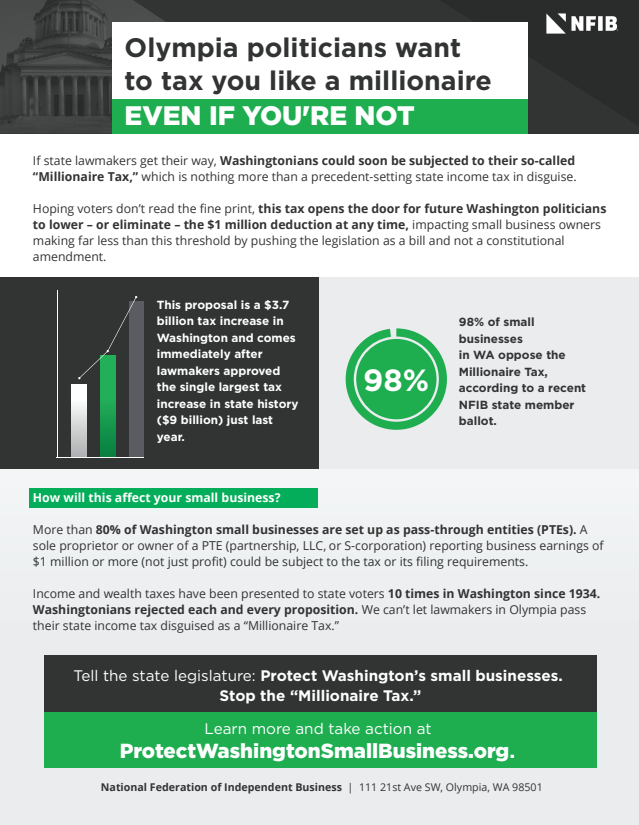
The so-called ‘Millionaire Tax’ creates a 9.9% income tax on households earning more than $1 million annually. But this falsely advertised tax does not limit itself to just millionaires. It will effectively operate as an income tax on sole proprietors and small-business owners organized as pass-through entities—85% of small businesses use this tax status.
Protect Washington Small Businesses
Protect Washington Small Businesses
The so-called ‘Millionaire Tax’ is bad for our state’s small businesses
The so-called ‘progressive revenue’ that the law promises to raise targets Main Street but exempts Wall Street. Your favorite local, family-owned restaurant or downtown retail shop may be forced to raise prices or consider closing its doors thanks to the Millionaire Tax, while billion-dollar national chains and big box stores somehow escaped it.
The law’s slim passage in the House (51-46), narrow approval in the Senate (27-22), and the thousands of Washington residents who used the Legislature’s online sign-in system to voice their opposition to the Millionaire Tax show big cracks in the measure’s support.
Lawmakers need to hear how this new tax will hurt the small businesses that some say it claims to help. To educate them on how this new income tax would affect your small business, please complete a brief survey:
- Created a Business & Occupation Tax surcharge (0.5%) on certain businesses grossing at least $250 million per year.
- Increased base B&O rates to 0.5% for all businesses, which takes effect January 1, 2027.
- Added sales tax to several services, such as IT, custom software, security, staffing services, digital advertising, and in-person instruction.
- Raised the capital gains tax from 7% to 9.9% on long-term gains of $1 million or more.
- Increased the estate tax to a new top rate of 35% on estates over $9 million.
- Raised gas taxes to 6¢ per gallon, increasing vehicle weight fees, raising the tax on vehicle sales from 0.3% to 0.5%, creating a new 8% luxury tax on noncommercial vehicles costing over $100,000, and raising the tire replacement fee from $1 to $5 per tire.
- Small business owners filing single or those filing jointly making at least $1 million annually would be impacted by this tax.
- Future legislatures can lower or eliminate the $1 million deduction at any time because this new income tax is created through a bill rather than a constitutional amendment. The Senate Majority Leader, and prime sponsor of the “Millionaire Tax” bill, has said as much.
- If you’re a sole proprietor or owner of a pass-through entity who reports business earnings and expenses on your personal federal income tax return, like a partnership, LLC, or S-corporation, and your business earns $1 million or more, you could be subject to the tax or its filing requirements.
- C-corporations are exempt from this new income tax.
- The tax will be based on your federal adjusted gross income (AGI), then you add in your portion of B&O taxes paid and any undistributed or retained earnings, deduct that year’s losses, subtract charitable contributions (under the limit), calculate any income from or taxes paid to other states, figure out if you paid more in B&O than your income tax liability, and more. With the complicated calculations expected to be a part of this new income tax, many small business owners who aren’t millionaires may be swept into this so-called “Millionaire Tax” based on business earnings, not take-home pay.
- Not exactly. Overturning a 1933 Washington State Supreme Court ruling would allow for an income tax to be imposed on all Washingtonians.
- Future legislators can repeal a 2025 initiative prohibiting state and local income taxes.
- Lawmakers could also exempt new taxes from it, just like the so-called “Millionaire Tax” legislation does.
- Most of this new, $4 billion-a-year tax revenue would go to the state’s general fund, which covers spending outside the transportation and capital budgets.
- Proponents plan to spend these funds on:
- Ending a Business & Occupation (B&O) Tax surcharge one year early for firms grossing $250 million (one-time revenue loss) – $500 million
- County public defense fund – $185-$280 million
- Sales tax exemption for grooming and hygiene products – $86 million
- Increasing the Working Families Tax Credit – $44 million
- Small business tax relief – $108 million by increasing the B&O tax filing threshold to $250,000, which exempts 65% of small firms, and doubling the Small Business Tax Credit for firms grossing up to approximately $500,000 per year.
- Big businesses, startups, and very small firms may see some relief, but the bill does nothing to help the small businesses that are likely to pay the new tax.
- NFIB is urging small business owners and supporters of small business to reach out to Governor Ferguson with a customized message using our simple email tool.
- NFIB balloted our members on the proposed “Millionaire Tax.” 98% of respondents oppose this income tax.
- NFIB’s Washington State Director and small business owners, including the chair of NFIB’s Leadership Council, testified before the state Senate Ways & Means Committee, offering solutions and bringing several key arguments in defense of Main Street:
- Sole proprietors and owners of pass-through entities will be ensnared in the new tax because it would apply to business earnings, not just salary or wages.
- Taxing undistributed funds or retained earnings would squeeze cash flow and jeopardize capital investments.
- Small businesses organized as pass-through entities are specifically targeted by the tax, while the bill exempts C-corporations entirely.
Radio Ad
One Pager
News

National Federation of Independent Business | 111 21st Ave SW | Olympia, WA 98501