


Topics:
NFIB Commends Gov. Scott’s Urgent Call for Property Tax Relief in His State of the State Address
NFIB Commends Gov. Scott’s Urgent Call for Property Tax Relief in His State of the State Address
January 7, 2026
"Main Street is struggling under the weight of high business taxes, high property taxes, chronic worker shortages, and a legislative fixation on bureaucratic red tape."
FOR IMMEDIATE RELEASE
BARRE, VT (Jan. 7, 2026) – The National Federation of Independent Business (NFIB), the nation’s leading small business advocacy association, released the following statement today regarding Governor Phil Scott’s annual State of the State Address:
“Vermont small businesses commend Governor Scott’s urgent call for property tax relief,” said John Reynolds, state director for NFIB in Vermont. “State lawmakers would be wise to follow Governor Scott’s lead on buying down sky high property tax bills with surplus funds, securing long-term tax relief for small businesses, and reducing – not growing – regulatory barriers to starting and growing a business in Vermont.”
Governor Scott has called for lawmakers to use surplus funds to buy down the 12% increase in the statewide education property tax projected by the Vermont Department of Taxes in the December 1 letter.
“Main Street is struggling under the weight of high business taxes, high property taxes, chronic worker shortages, and a legislative fixation on bureaucratic red tape,” added Reynolds. “The last thing small business owners need is for their taxes to double under proposals that claim to fix the property tax burden, or for lawmakers to pile on new regulations and lawsuits like what is proposed in the so-called Workplace Temperature Regulation proposal. We urge lawmakers to give Vermont small businesses a break.”
Vermont small businesses are facing a massive tax increase under H.177, a proposal to eliminate homestead property taxes by shifting the burden onto small businesses and workers. This bill would effectively double the state’s income tax rates while forcing small businesses, farms, and other non-homestead property owners to keep paying property taxes.
Small businesses that are pass-through entities pay taxes at individual rates and would be hardest hit. According to U.S. Census Data, 92% of all businesses in Vermont are pass-through entities with fewer than 20 employees. Meanwhile, the bill does not change the corporate tax rate.
Lawmakers have also proposed a wide range of new mandates and regulations, including a complex set of workplace temperature regulations (S.153, H.348) that would impact thousands of workplaces across the state. That proposal would subject small businesses to duplicative micromanagement by Montpelier and ruinous litigation for ambiguous violations.
###
For over 80 years, NFIB has been advocating on behalf of America’s small and independent business owners, both in Washington, D.C., and in all 50 state capitals. NFIB is nonprofit, nonpartisan, and member-driven. Since our founding in 1943, NFIB has been exclusively dedicated to small and independent businesses, and remains so today. For more information, please visit nfib.com.
State:
Get to know NFIB
NFIB is a member-driven organization advocating on behalf of small and independent businesses nationwide.
Related Articles

April 8, 2026
New York Small Businesses Win Legal Challenge to Onerous New Wetlands Regulations
NFIB joined a lawsuit in 2025 challenging a harmful, vague wetlands mandate in New York.
Read More

April 8, 2026
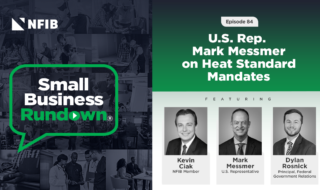
U.S. Rep. Mark Messmer Discusses Heat Standard Mandates on NFIB’s Podcast
Congressman Messmer joined NFIB’s Small Business Rundown podcast.
Read More

April 8, 2026
Small Businesses Oppose Overreaching Federal Heat Standard
WASHINGTON, D.C. (April 8, 2026) – The National Federation of Independent Business (NFIB), the nation’s leading small business advocacy organization, opposes t…
Read More

April 8, 2026
COLUMN: An ‘OK’ Session for Small Business, With a Lot More Work Ahead
In a year filled with new taxes and mandates, “OK” counts as a win
Read More