


Topics:
May 8, 2026
Mass., Minn. offer cautionary tales on the downside of taxing upside
________________________________________________________________________________________________
MAY CAPITOL UPDATE: VT Small business owners are facing another massive property tax hike, and some lawmakers want to double your business taxes. >>>>> Take Action: Stop Main Street Tax Hikes in Vermont – NFIB <<<<<
_________________________________________________________________________________________________
What some lawmakers have dubbed a “wealth tax” aimed at high income Vermonters is really a Growth Tax that will hit many small businesses.
We previously explored how a top personal income tax rate of 13.3% and an investment surtax of 4% would impact Vermont. The implications were not encouraging.
For some Vermonters, the Growth Tax package will create a top state tax rate of 17.3%.
In contrast, the next highest state capital gains tax rate is California at 13.3% which is also their top personal income tax rate (above $1.5 million for married joint filers).
Vermont needs to keep and attract more workers, investors, and entrepreneurs up and down the income ladder.
It can do this by making life more affordable, reducing a tax burden that ranks in the bottom ten nationally, and establishing a pro-growth tax climate.
Tax-Driven Demographics and Investment. As the non-partisan experts at the Tax Foundation explain, tax burden is a key component of domestic migration between states:
“… millions of Americans, along with significant amounts of income and economic activity, are moving from high-tax states to those with more competitive tax systems and lower overall costs of living. Tax differentials may not be the primary reason for an interstate move, but they are often one of several factors people consider when deciding whether—and where—to move.”
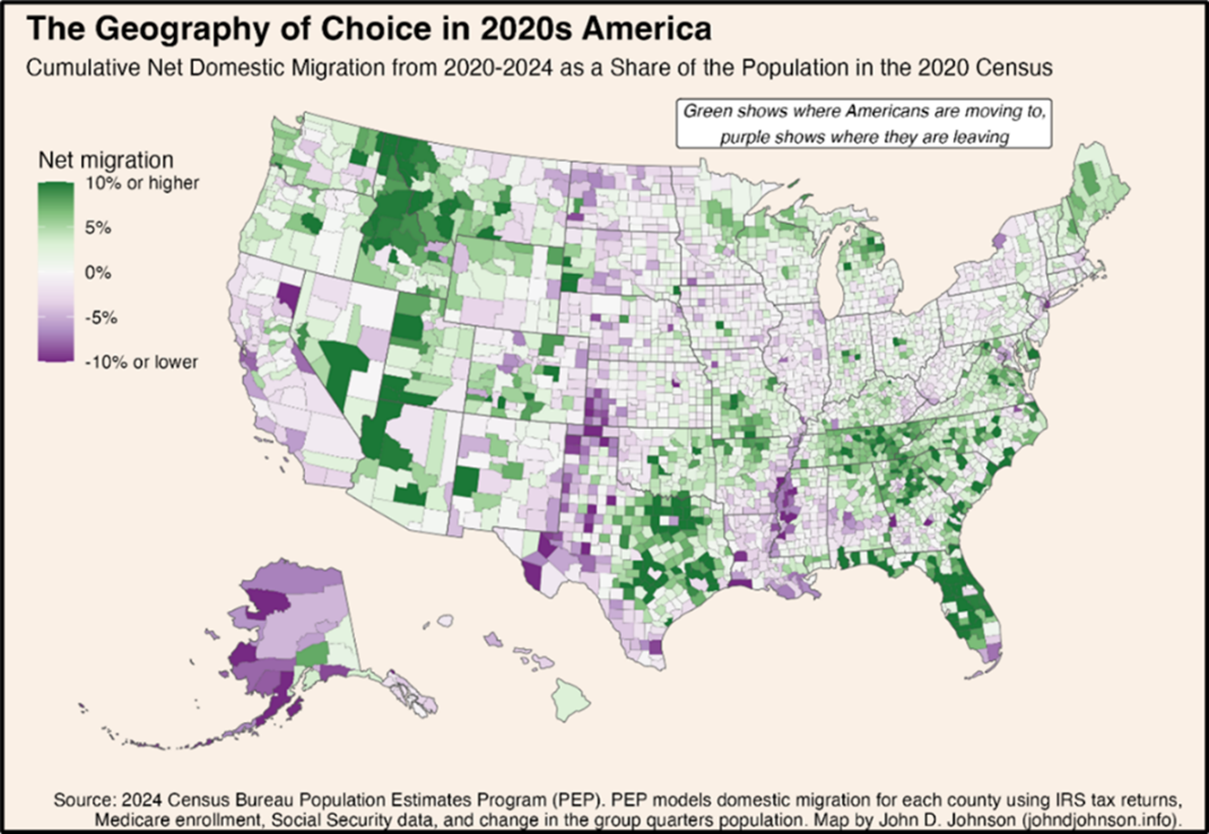
The domestic migration map from 2020-2024 shows a clear preference for low tax states in the southeast and mountain west, and the map for 2025 tells the same story.
Proximity, relative affordability, and relative tax burden matter too.
By having one of the least competitive tax climates in the country, Vermont is missing out on a prime opportunity to benefit from a sustained influx of people, capital, and growth from nearby states with high tax burdens and costs of living.
Moreover, tax rates impact business location and investment decisions. Lower tax burdens mean more local firms, stronger employment, and higher wages.
Making Vermont’s tax climate worse will make the total affordability picture worse.
Bay State Migration: In 2023, Massachusetts enacted a 4% surtax on income above $1 million (adjusted annually for inflation).
The long-run effects of the Massachusetts Tax are still being debated, but three things are clear:
- Net Domestic Migration Loser. Like other high tax states, Massachusetts was a net domestic population migration loser before the tax and continues to be a net population loser after the tax, according to U.S. Census data.
From 2020 through 2025, Massachusetts experienced a net domestic population migration loss of 182,145 people. Net migration loss in those years ranged from a low of 9,400 in 2022 to a high of 48,000 in 2022.
- Net Income Migration Loser. Massachusetts was a net domestic income migration loser before the tax and continues to be a net income migration loser after the tax, according to Internal Revenue Service data.
Losses due to domestic income migration picked up during the pandemic, going from -$1.4 billion from 2018-19 to -$4.3 billion in 2020-21. Income migration loss declined the next year, before picking up in the first year following the new tax (2022-23: -$4 billion).
- Higher Earner Exodus. At first glance, the population and income migration trends may look like no big deal. People and their money had been leaving Massachusetts since 2020, with the amounts varying by year.
However, the composition of the exodus is changing substantially.
Per the Illinois Policy Institute, from 2016 to 2019 the share of domestic income outflow attribute to those with income over $200,000 ranged from 32% to 36%.
That percentage increased sharply in the early part of the pandemic (2020: 47%, 2021: 60%) before subsiding a bit in 2022 (55%).
Then came the new tax, and things took another turn. Per IPI:
“However, the effects of high-income outmigration are most felt in the share of income the state loses. More than 70% of the lost income in Massachusetts was from those making more than $200,000 a year, even though they made up only 28% of those who left the state.
“That 70% of net income loss for a state from those making over $200,000 is the highest amount recorded for that income group since the IRS began tracking the data in 2011-2012 tax returns.”
The marked uptick in 2023 strongly suggests that the new tax, coupled with post-pandemic shifts in work and living decisions, is a factor in the domestic migration and income exodus from Massachusetts.
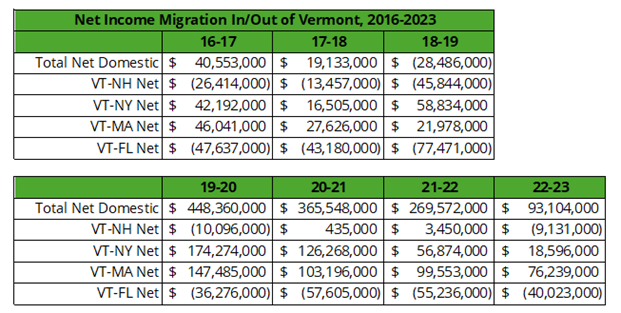
Just Another Band Out of Boston. With a more favorable overall tax climate, Vermont could have seen a major influx of high earners from Massachusetts, but this is not what happened.
Rather, the net gain in income migration from Massachusetts continued to decline from the pandemic era high.
Source: US IRS SOI, NFIB Vermont
Even as net domestic income migration out of Massachusetts remained elevated, the share going to Vermont spiked early in the pandemic and then declined to pre-pandemic levels:
2018-19: 2%
2019-20: 6%
2020-21: 2%
2021-22: 3%
2022-23: 2%
At a time when Massachusetts continued to be a net domestic income migration loser, why did the share of domestic income migration from there to Vermont decline so quickly to pre-pandemic levels?
The Minnesota Example: Purple Pain. Back in 2013, Minnesota increased its top income tax rate from 7.85% to 9.85% for single filers with annual income over $150,000 and married joint filers with more than $250,000.
By many measures, the state’s economic growth has slowed ever since.
According to the Minnesota Chamber of Commerce, the state’s labor productivity has steadily declined, the workforce participation rate remains well below pre-pandemic levels, the state is losing manufacturing and business services jobs, and patent activity and R&D growth have declined since 2014.
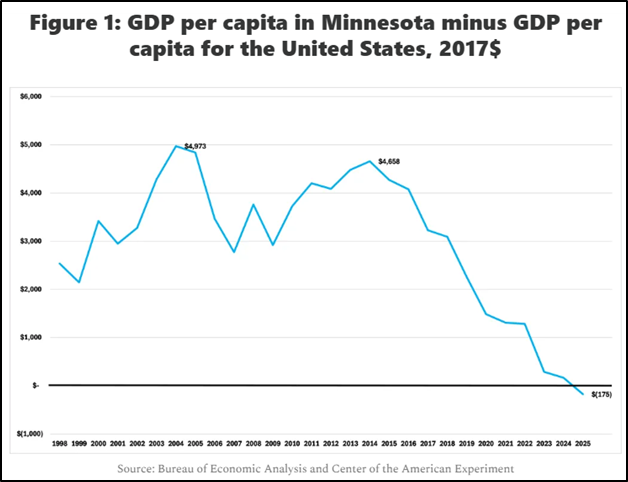
Per Capita Income Decline. In 2014, per Minnesota-based economist John Phelan, the Gopher State began a precipitous decline in per capita Gross Domestic Product (GDP) relative to the national average. As Phelan explains, per capita GDP:
“… is a general measure of welfare, telling us how much per person is available to be consumed, invested, or put to some other use. If we want to increase economic welfare, we should pursue policies that increase per capita incomes.”
From 1997 through 2013, Minnesota’s annual per capita GDP grew faster than the national average in 10 of 17 years.
From 2014 through 2025, Minnesota’s per capita GDP growth trailed the national average every single year.
Even though Minnesota’s per capita GDP growth rate exceeded the pre-2014 period, it still lagged far behind the national average.
What does this mean in practical terms? Minnesota’s per capita income went from being well above average to below average in about a decade. Per Phelan:
“…as recently as 2014, GDP per capita in Minnesota was $4,658 above that of the United States generally, or $18,632 for a family of four. In every year since 2014, that premium has fallen until, last year, it vanished completely and Minnesota became, for the first time on record, a state with below average per capita GDP.”
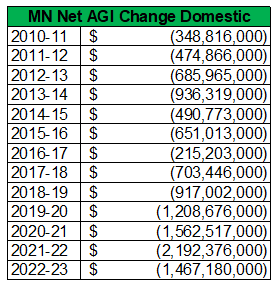
Sustained Domestic Income Migration Losses. In addition, or related to, the decline in per capita GDP, Minnesota experienced a substantial decline – over $10 billion – in taxable personal income due to domestic migration from 2013 to 2023.
Source: U.S. IRS SOI Tax Stats, NFIB Vermont
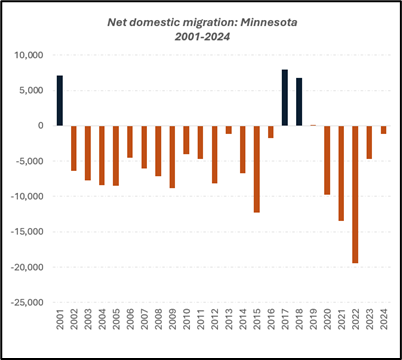
Even in years when Minnesota gained or suffered only marginal losses in population due to domestic migration, the state still saw steep declines in the amount of taxable personal income.
Source: Minnesota Chamber of Commerce, U.S. Census Bureau
Why Did People Leave Minnesota? Taxes aren’t the only factor, but it’s widely recognized that taxes play a role in where people decide to live. Taxes are also a major factor in where companies decide to invest.
Minnesota’s tax burden has historically been high, ranking in the bottom eight of the Tax Foundation’s State Tax Competitiveness Index going back to 2010 and before.
So, it’s no surprise that income flight due to domestic migration existed before the 2013 tax hike.
But it’s notable that net domestic migration income loss increased by 36% from 2013 to 2014.
The rapid acceleration of net income loss during the pandemic suggests the state’s high tax burden, coupled with a strong preference for sunny southeastern states and snowcapped peaks in the mountain west, newfound remote work flexibility and a frothy job market, opened the door for more people and more income to flee.
Weather and age are often cited as other factors, along with affordability.
It’s extremely cold for much of the winter, but Minnesota can’t just blame the weather.
More favorable tax climates in the Dakotas and Wisconsin are among the common landing spots for Minnesotans, alongside Arizona, Florida, and Texas.
And it’s not just retirees either. In recent years, Minnesota has been losing people from across the age and income spectrum (during the pandemic, Massachusetts ranked among the five worst states for net outmigration among millennials).
It all begs a question relevant to Vermont: can a state be chilly and high tax forever?
The experience in Minnesota suggests the answer is no.
Why Should Vermont Care? The Minnesota example shows what happens when a state increases taxes while surrounded by states with lower rates.
For small businesses, investors, and other mobile people, an increase in income and investment taxes further erodes the advantages that attract people to Vermont from Massachusetts and New York.
With property taxes rising, energy costs up, healthcare costs up, stagnant economic momentum and other factors worsening the affordability problem, discouraging investment and income migration with punitive taxes on income and investment will hurt Vermont.
The map is clear: states with lower tax burdens have been the big winners in the post-pandemic population and income migration shifts.
If Vermont wants to attract people and grow its economy, pair the state’s natural beauty and bountiful outdoor recreation opportunities with a lower tax burden.
State:
Get to know NFIB
NFIB is a member-driven organization advocating on behalf of small and independent businesses nationwide.
Related Articles

Related
May 22, 2026
Millionaire Tax, New Mandates Mark Another Tough Session for State’s Small Businesses
Despite setbacks, NFIB defeated 90% of bills most harmful to small businesses
Read More


Related
May 20, 2026
Post-Primary Comment on the Defeat of Measure 120
Voters send clear message: State government should live within its means
Read More

Related
May 20, 2026
NFIB on C-SPAN: How Small Businesses are Managing Economic Pressures
A discussion on C-SPAN featuring an NFIB expert covers the current state of the small business economy and the top issues that are impacting Main Street.
Read More

Related
May 19, 2026
Small Businesses Encouraged by Introduction of Ohio Gas Tax Reduction
House Bill 850 proposes an immediate 50% reduction for three months.
Read More