November 24, 2025
Future of property tax savings through administrative consolidation and school reform is unclear
In November, a majority of Vermont School Redistricting Task Force members opted for a voluntary approach to school governance reform. This move leaves education cost savings and property tax relief, promised as part of an education overhaul passed last June, in limbo.
Act 73 Background. Earlier this year, Governor Phil Scott and Vermont lawmakers agreed to a sweeping education reform law built around shifting state support to a “foundation formula” and school governance reform. For most proponents, including Gov. Scott, the goal was to reduce the property tax burden by getting the cost of education under control.
The package, known as Act 73, changes how the state funds local schools, alters which schools qualifying for tuition, and sets minimum class sizes.
Act 73 also established a school redistricting task force which was charged with finding ways to consolidate school districts that would make the education system more efficient and provide relief to property taxpayers. Specifically, the task force was tasked with three options for transitioning from more than 150 school governing units to 10-20 larger school districts across the state.
Over the course of eight meetings, the task force struggled to coalesce around new school governance maps. Some members gravitated toward a mandate for new, larger districts based on existing Career and Technical Education Districts, which was rejected by the majority of the task force in November. Others proposed adopting a New York-style BOCES (Cooperative Education Service areas) framework that encourages cost reduction through shared services.
Voluntary Consolidation & Cooperative Service Areas. Ultimately, a divided task force (8-3) adopted a draft report that recommends a 10-year phase in of and incentives for school districts to join one of five cooperative service areas.
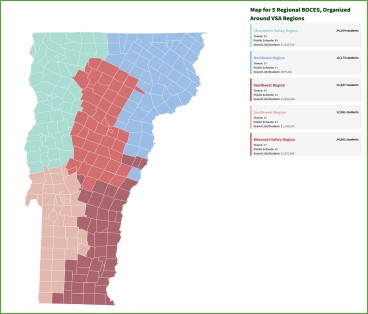
Those who supported the voluntary, BOCES-style plan believe that shared service arrangements will achieve cost savings without mandating disruptive school district consolidation.
Gov. Scott expressed disappointment with the task force for failing to present options for governance reform that would deliver the promised property tax relief.
What happens next? The Vermont Legislature is under no obligation to adopt new regional school district boundaries next year, but failing to do so means a key piece of the education reform and property tax relief puzzle will be unresolved heading into the next legislative session.
Meanwhile, Act 73 is bringing about change even without a statewide plan for governance reform.
According to a Vermont Public report, the law’s class size minimums are forcing discussions about district consolidation and school closure. At least fourteen districts are in talks about consolidation or closing schools.


Source: Vermont Public, 11/20/2025
Rural school districts have continued to express concern that Act 73 will force significant disruption throughout much of Vermont.
What does this mean for property taxes? In early December, the Scott Administration will release the estimated increase in statewide property tax increases for next year.
Significant increases in health insurance costs for school employees and other public sector workers, combined with other factors, could lead to a sizeable projected increase. Lawmakers will have to decide whether and how to buy down the increase, as they did this year at a cost of $120 million in surplus taxpayer funds.
A large increase could jolt lawmakers into taking more meaningful and lasting action to address the property tax burden.
As we’ve already seen, some parts of Act 73 will force changes regardless of how Vermont lawmakers handle the task force’s report next year. But further action is likely necessary to put the state on track for substantial property tax savings.
NFIB is a member-driven organization advocating on behalf of small and independent businesses nationwide.
Related Articles