


Topics:
May 28, 2026
Governor Hochul, state lawmakers agreed to substantial rollback of expensive climate law
Governor Scott and Vermont lawmakers will accomplish many substantial reforms during the 2026 Vermont Legislative Session, but reform of the state’s Global Warming Solutions Act (GWSA) stands as a major missed opportunity.
Surprisingly, New York has created a roadmap for Vermont on how to rein in impractical and financially impossible climate mandates. In this year’s state budget, Governor Kathy Hochul, a Democrat, worked with Democratic majorities in the New York Legislature to reform their state’s major climate law – the Climate Leadership and Community Protection Act of 2019 (CLCPA).
The CLCPA and GWSA share similar timelines, mandates, and costs, but New Yorkers will be spared some of the near-term economic pain and energy disruption as a result of reforms in the budget agreement.
What changed in New York? Two events forced the hands of New York politicians.
First, last October a state court judge ruled the Hochul Administration was in violation of the CLCPA for failing to implement programs that would meet the law’s requirement that greenhouse gas (GHG) emissions be reduced 40 percent from 1990 levels by 2030. The state had argued that compliance “would require imposing extraordinary and damaging costs upon New Yorkers.”
The court told the administration that the law’s deadlines were unambiguous and immutable, and to either change the law or comply with it.
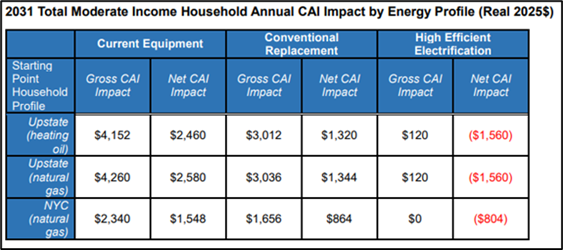
Second, in February the New York State Energy Research and Development Authority released a report showing the costs of CLCPA compliance really would be disastrous for New Yorkers.
What did New York lawmakers do about it? Most significantly, New York created more breathing room for consumers and small businesses by altering the CLCPA’s first two GHG reduction mandates.
Instead of requiring the state to meet the CLCPA’s mandate of reducing GHG emissions 40% by 2030 and generating 100% GHG-free electricity by 2040, the state now must reduce emissions 60% by 2040 (compared to 1990 levels).
Importantly, the new 2040 requirement includes flexibility to avoid imposing what the New York Attorney General argued are “extraordinary and damaging costs.” State officials can consider whether meeting that target is “feasible and cost effective.”
New York also changed how it measures GHG impacts, aligning it with the 100-year timeframe used by Vermont and many other states.
Are New Yorkers out of the woods? Not quite. While the agreement modified the near- and medium-term GHG reduction requirements, it left in place the mandate for the state to achieve an 85% reduction by 2050.
It also delays – but does not repeal – the deadline for the state to implement programs that will put the state on track to meet the 2040 and 2050 mandates. The CLCPA required the Hochul Administration to issue those regulations in 2024; the lack of action prompted the lawsuit that led to the state court ordering compliance. Now, the governor has until 2028.
Prior to these changes, there was a broad expectation that CLCPA compliance meant implementing a carbon tax system like what has been studied in Vermont.
What does this mean for Vermont? Vermont’s GWSA remains a looming threat that, when enforced, will make life even more unaffordable for small businesses and families in the Green Mountain State.
As the New York report on CLCPA compliance shows, the average family could be hit with more than $4,000 in increased energy costs and the average small business faces $7,000 in higher bills every year.
Governor Phil Scott for years has called for major changes to the GWSA to avoid these punishing costs:
– convert the 2030, 2040, and 2050 mandates to goals, giving the state more flexibility to reduce GHG emissions in a cost-effective manner
– eliminate the GWSA’s “right to sue” provision, which allows out-of-state special interest groups to force Vermont to impose expensive energy taxes through the courts – while forcing Vermonters to pick up the legal tab
– return power over the state’s energy future and cost of living to elected officials instead of unelected boards and judges
The Green Mountain State accounts for a miniscule share (0.016% in 2022) of global GHG emissions. It also has very clean air and has seen substantial reductions in particulate matter over the last two decades.
The state should continue building on this progress without imposing damaging new costs on families and small businesses.
Governor Scott’s reforms make sense and there is some bipartisan support for them at the State House in Montpelier. However, Democratic legislative majorities have blocked serious consideration of GWSA reform for the past two years. This is a major missed opportunity that could come back to haunt Vermonters.
In November, voters will decide whether they want lawmakers who will continue making life more expensive or lawmakers who recognize reality and can put Vermont on a better course.
State:
Get to know NFIB
NFIB is a member-driven organization advocating on behalf of small and independent businesses nationwide.
Related Articles
Related
July 8, 2026
Vermont Small Businesses Welcome Gov. Scott’s Executive Order on Healthcare
The executive order expedites badly needed reforms and sets the stage for future action.
Read More


Related
July 8, 2026
Wall Street Journal: Congress Risks Key Victory If Corporate Transparency Act Is Not Repealed
WASHINGTON, D.C. (July 8, 2026) – Wall Street Journal Opinion Columnist William McGurn published an opinion piece outlining the importance of repealing the Cor…
Read More

Related
July 7, 2026
LISTEN: NFIB’s Josh McLeod Gives Update on Efforts to Repeal Invasive Federal Mandate On Raleigh Radio
Main Street continues urging Congress to repeal BOI reporting requirements.
Read More

Related
July 6, 2026
LISTEN: NFIB’s Josh McLeod Gives Update on Efforts to Repeal Invasive Federal Mandate in Louisiana Radio Interview
Main Street continues urging Congress to repeal BOI reporting requirements.
Read More