


Topics:
August 5, 2025
Global Warming Solutions Act (GWSA) Right to Sue Remains Threat to Taxpayers
In July, a Vermont Superior Court judge dismissed the first lawsuit filed under the “Right to Sue” provision of the 2020 Global Warming Solutions Act (GWSA).
The lawsuit was filed last year by the Boston-based Conservation Law Foundation (CLF), which claimed the Vermont Agency of Natural Resources (ANR) failed to update state rules to meet the GWSA’s first mandatory emissions reduction deadline in 2025.
Under the GWSA, the state’s Climate Council is responsible for creating a Climate Action Plan that outlines strategies for meeting the GWSA greenhouse gas reduction mandates.
Read more about the cost of and problems with the Climate Council’s plan HERE.
The GWSA also lays out a series of deadlines for administrative actions by ANR to meet the mandates. 10 V.S.A. 593. The deadline at issue in this matter was for ANR to, on or before July 1, 2024:
“… review and, if necessary, update the rules required by subsection (b) of this section in order to ensure that the 2025 greenhouse gas emissions reduction requirement pursuant to section 578 of this title is achieved. In performing this review and update, the Secretary shall observe the requirements of subsection (c) of this section.”
The State’s Response. ANR argued that CLF’s lawsuit was not a permissible use of the GWSA Right to Sue because ANR conducted the review and made the necessary determination not to update the rules by the July 1, 2024 deadline.
The court agreed that CLF’s challenge was not permitted under the GWSA.
Siding with CLF would have meant anyone could sue the state – at the taxpayer’s expense – not only to enforce the emissions reduction mandates themselves but also over disagreement with decisions that ANR had sole discretion to make under the GWSA.
Future Implications. While loaded with technical interpretations of a complex law, the core of the case was about how much discretion the state retains over how to meet the GWSA’s very expensive reduction mandates.
As projected in Vermont’s most recent Greenhouse Gas Emissions Inventory and Forecast (July 2025), emissions are not falling fast enough to not meet the 2025 or 2030 GWSA mandates. The final January 1, 2025 tally will not be known until 2027 or 2028, but more lawsuits will likely come in the meantime.
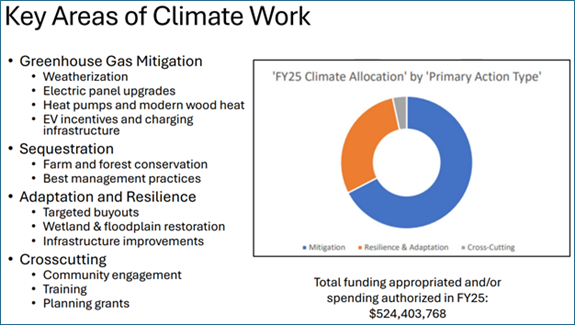
The programs needed to meet the GWSA deadlines will cost Vermonters billions in the coming decades. That’s on top of over $500 million on emissions reduction programs and climate mitigation projections in Fiscal Year 2025 alone.
Taxpayers deserve for those decisions to remain in the hands of elected officials and appointees who can be held accountable by voters, not unelected activists and lawyers.
So long as the ill-advised Right to Sue remains in law, this is likely just the first Costly Climate Lawsuit that Vermont will face in the coming years and decades.
Numerous proposals to repeal the Right to Sue and convert the GWSA mandates back to goals were bottled up in legislative committees earlier this year.
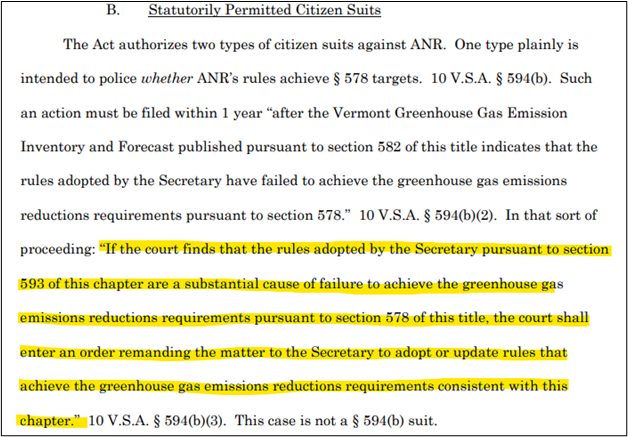
As the court highlighted, failure to meet the GWSA mandates could result in unelected activists, lawyers, and judges ordering the ANR to take action – at the expense of hardworking Vermont taxpayers:
NFIB VT will continue to support legislation that eliminates the GWSA Right to Sue and gives the state – and taxpayers – greater flexibility and financial breathing room from the heavy-handed mandates.
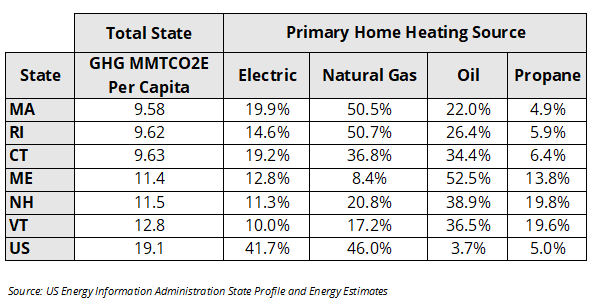
Vermont’s GHG Emissions. Vermont emits the least amount of GHGs in the country and its per capita emissions are one third below the national average.
Its 8.25 million metric tons (MMTCO2e) of emissions account for just 0.016% of global GHG.
While activists point to Vermont having the highest GHG emissions per capita in New England in justifying massive taxpayer-funded intervention, that analysis fails to account for massive differences in where people live and work within each state, how each state heats homes and buildings, and other factors.
For example, the three southern New England states all have far higher rates of natural gas home heating, which produces far fewer GHG emissions than heating oil more commonly used in the latter states.
Moreover, far greater shares of the population in southern New England live in dense metropolitan areas compared to Northern New England. This impacts each state’s share of GHG emissions, particularly from the transportation sector.
State:
Get to know NFIB
NFIB is a member-driven organization advocating on behalf of small and independent businesses nationwide.
Related Articles

Related
June 4, 2026
2026 Vermont Legislative Recap Part III: Small Business Regulations
Small businesses will need to watch out for some new regulations.
Read More

Related
June 4, 2026
2026 Vermont Legislative Recap Part II: Healthcare, Energy
Energy and healthcare costs play a major part in VT’s affordability problem.
Read More
Related
June 3, 2026
2026 Vermont Legislative Recap Part I: Small Business Taxes
Income, Property, and Transportation Tax Debates Loomed Large This Year.
Read More
Related
May 28, 2026
Bipartisan Agreement Rolls Back Vermont Land Use Restrictions
Rural outcry leads to repeal of “Road Rule” and “Tier 3” restrictions.
Read More