


Topics:
May 26, 2026
Where good bills go into but never come out of
Welcome to the May 26-29 edition of the Main Street Minute from your small-business-advocacy team in Sacramento. We took yesterday off to join with our fellow Americans in honoring those who put on the uniform of our nation and never made it back to enjoy the freedom they fought for.
The Legislature’s Twin Black Holes of the Universe
Regular readers of the Main Street Minute are aware of two tools legislators use to avoid dealing with inconvenient bills. One is to bury them in the suspense file, and the other way, much more involved rarely used, is to gut-and-replace a proposal’s content.
A third, and much more common way, is to simply not give a bill a hearing at all. This is being done to two measures NFIB is strongly supporting. That both bills would curb rampant lawsuit abuse, we’ll leave it to others to say who is erecting their barriers to passage, but it shouldn’t prove much of a strain on anyone’s imagination.
The problem for legislative leaders is that not giving Assembly Bill 649 and Senate Bill 84 a hearing is proving embarrassing. AB 649, creating a Small Business Right to Cure program, passed the Assembly on a remarkable 78-0 vote. Upon its arrival in the Senate, it was assigned to that body’s Judiciary Committee and has not been acted on since July 14, last year.
Similarly, SB 84, allowing 120 days to correct a violation of certain state laws, sailed out of its house of origin on a big bipartisan 34-2 vote. Upon its arrival in the Assembly, it was assigned to that body’s Judiciary Committee and has not been acted on since June 18, last year.
The Assembly Judiciary Committee and the Senate Judiciary Committee are the twin black holes of the legislative universe this session, swallowing good, bipartisan-passed bills whole.
Can AB 649 and SB 84 be rescued? The legislative calendar is presenting a formidable obstacle.
Starting today, May 26, and for the rest of the week, only floor sessions are being held. No policy committees are allowed to meet.
— On June 1, policy committees can resume their work.
— July 2 is the last day for policy committees to meet and pass bills.
— After business on July 2, the Legislature goes on summer recess until August 3
— August 31, Legislature adjourns.
The treatment of both bills is an outrage.
Governor’s May Revision of the State Budget
“For several years, we have cautioned that structural deficits were emerging and would soon require corrective action. Despite the current revenue boom, the state now faces a structural budget imbalance—meaning ongoing revenues are insufficient to support ongoing expenditures,” reports the Legislative Analyst’s Office about Gov. Gavin Newsom’s May revision of the 2026-2027 State Budget.
“In January, we noted that our office and the administration estimated the state faced future deficits between $20 billion and $30 billion per year. Due to a combination of higher revenue estimates, lower baseline spending, and ongoing proposals (which both raise revenue and reduce spending), the May Revision cuts these future deficits in half. Despite this progress, the underlying budget condition is not sound. First, the existence of any operating deficits during a revenue boom of this magnitude is itself a warning sign. Further, given the state’s diminished reserves and already accumulated wall of debt, California is ill-prepared for even a slip up in revenues.”
Full LAO report here.
The Regulatory World
From Nielsen Merksamer’s Weekly Report
— May 21, the Governor signed Executive Order N-6-26. The order requires the Labor and Workforce Development Agency (LWDA), GO-Biz, and the Department of Finance, in consultation with others to provide a report on the emerging body of academic research identifying the potential workforce impacts of technological shifts of artificial intelligence (AI) by August 19.
— May 20, the California Air Resources Board submitted its Greenhouse Gas Reporting and Climate Risk Disclosure Regulation to the Office of Administrative Law (OAL). OAL has until July 2 to conduct its review.
— Cal. Air Resources Board Meeting – May 28 9:00 am (Sacramento & virtual). The agenda includes the potential adoption of the 2026 State Implementation Plan Revisions for the California Extreme Ozone Nonattainment Areas, updates to the Mandatory Reporting of Greenhouse Gas Emissions Regulation, and updates to the California Cap on Greenhouse Gas Emissions and Market-Based Compliance Mechanisms Regulation. If needed the Board may continue the meeting the following day, Friday May 29, at 9:00 am.
Damn Powerful Pair of Shoes
From retail researcher Morning Consult. “Nike is the undisputed mental availability leader in athletic apparel — 22% Mental Market Share, the broadest Network Size in the category, 84% mental penetration among brand-aware consumers, and the highest emotional connection score of any brand. The brand’s strength is real, broad, and structurally durable.”
Calendar
— May 18: Last day to register for the June 2 Primary Election
— May 29: Last day for bills to pass their house of origin
— June 2: Primary Election for eight state constitutional offices, four Board of Equalization seats, all 52 congressional seats, all 80 assembly seats, and 20 (even-numbered districts) state senate seats.
— June 2: All ballots returned by mail must be postmarked on or before June 2 and received by county elections offices no later than June 9
— June 15: Deadline (by midnight) to pass new state budget
— July 2-August 3: Legislature on Summer Recess
— August 31: Legislature adjourns its 2026 session
— September 30: Last day for governor to sign or veto bills sent to him.
National
Highlights from Federal Government Relations Principal Louis Bertolotti’s weekly report
— NFIB joined a coalition letter calling upon the House Energy and Commerce Committee to include the REPAIR Act in their markup hearing for the surface transportation reauthorization bill: “Vehicle owner and independent shop access to vehicle repair data is increasingly at risk as Original Equipment Manufacturers (OEMs) tighten control over its availability. Today, OEMs collect terabytes of data from their vehicles wirelessly and store it in their cloud servers. The OEMs then unilaterally decide to whom they give access to this data and under what terms and conditions”
— NFIB sent a letter to the Department of the Treasury in opposition to the Office of the Comptroller of the Currency interim final rule which allows card processors to set swipe fees and prevents state laws from addressing the rising cost of swipe fees. SBLC Vice President and Executive Director Beth Milito said, “Swipe fees have become one of the highest overhead costs for small business owners nationwide. At every turn, this interim rule contradicts the previous standard in favor of big banks and credit card companies. Now, banks and card processors can collude to set even higher swipe fees, padding their bottom lines at the expense of small businesses and consumers.”
— NFIB filed an amicus brief in the case Suncor Energy v. Boulder County at the United States Supreme Court concerning whether federal law prevents state-law claims based on greenhouse gas emissions. Beth Milito said, “Allowing these lawsuits to continue, as the Colorado Supreme Court did in this case, will set a precedent for every state and local government, or individual, to seek legal relief for greenhouse gas emissions. NFIB is hopeful that the Supreme Court puts an end to these lawsuits once and for all.”
Next Main Street Minute: June 1. All Main Street Minutes can be found on the NFIB website here. Pull down the California tab in the upper-right-hand corner, or, to get right to it here, www.nfib.com/california.
State:
Get to know NFIB
NFIB is a member-driven organization advocating on behalf of small and independent businesses nationwide.
Related Articles
Related
May 28, 2026
What’s Wrong With The Legislature Can Be Explained In These Two Bills
How can measures passing 78-0, 34-2 never get a hearing in the other chamber?
Read More

Related
May 26, 2026
New NFIB Op-Ed: Unleash Small Business Growth in Additional Reconciliation Bill
New package should bolster small business success with crucial tax, regulatory, and healthcare reforms
Read More

Related
May 20, 2026
Reminder: 2026 Annual Filing Report Due June 30
Pennsylvania small business owners are required to file an Annual Report to the Pennsylvania Department of State. This is a new requirement that started in 202…
Read More
Related
May 20, 2026
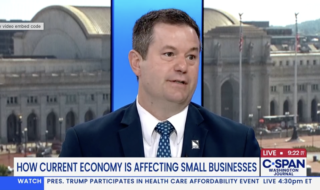
NFIB on C-SPAN: How Small Businesses are Managing Economic Pressures
A discussion on C-SPAN featuring an NFIB expert covers the current state of the small business economy and the top issues that are impacting Main Street.
Read More