


Topics:
February 2, 2026
Is a new transportation tax being teed up?
Welcome to the February 2-6 edition of the Main Street Minute from your small-business-advocacy team in Sacramento.
Ready for a Transportation Tax?
It was introduced as far back as February of last year, and on Thursday (January 29), it made the January 31 deadline for bills to be passed out of their house of origin or die for the rest of the legislative session.
Assembly Bill 1421 “would require the [California Transportation] commission, in consultation with the Transportation Agency, to consolidate and prepare research and recommendations related to a road user charge or a mileage-based fee system. The bill would require the commission to submit a report, as specified, on the research and recommendations described above to the appropriate policy and fiscal committees of the Legislature by no later than January 1, 2027.”
According to the Assembly Floor Analysis of AB 1421, “Advancements in the automotive industry and a desire to reduce the dependence on fossil fuels have led to the development of more fuel-efficient vehicles, such as hybrids and zero-emission vehicles (ZEVs). Recently, California’s goals to reduce greenhouse gas (GHG) emissions have driven the adoption of more fuel-efficient vehicles, which has reduced fuel consumption. The growing adoption of zero‑emission vehicles and increasing fuel efficiency in internal combustion engine vehicles will lead to a decline in state transportation revenues over the long run, particularly from the gasoline excise tax.
— “This problem is not unique to California. For example, Connecticut estimates that their gas tax revenues fell by 4.2% between 2012 and 2021 due primarily to vehicle electrification. West Virginia estimates that their gas tax revenue will fall 11–20% by 2030 and 31–50% by 2050 due to vehicle electrification. A recent study in Michigan estimated that despite ZEVs representing only 6% of the new vehicle market, vehicle electrification resulted in a funding deficit of $20.8 million in 2022. That funding deficit is expected to increase to over $95 million per year by 2030.”
A mileage-based fee, or Vehicle Miles Traveled (VMT) tax, has never been popular with NFIB members across the nation. The last time NFIB California members were asked about it was in 2015, and they were pretty adamant. “Should California add to the current tax on motor fuel a vehicle miles traveled (VMT) tax to fund future highway and road construction and maintenance?” Yes 6%; No 91%; Undecided 3%.
Have times changed? NFIB will be consulting its members for their opinions.
Ballot Initiatives Ahead
Last Tuesday (January 27), Swing Strategies’ Tom Ross and Tino Rossi gave a presentation on the initiatives competing for placement on the 2026 General Election ballot. Highlights from their remarks and slides included:
Since 1912, when the initiative process was instituted, there have been 2,148 given title and summarized for circulation. Of those, only 7% eventually passed in the 113 years of the process
— Reminder: citizens must gather signatures for ballot initiatives; the Legislature can just add them without going through a signature-gathering phase.
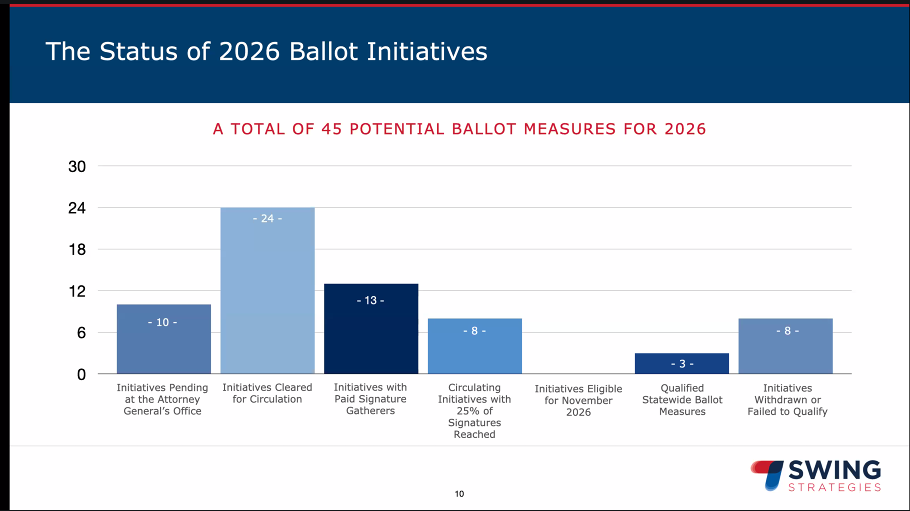
Currently, there are 45 potential ballot measures for 2026. Swing Strategies breaks down their status in this slide.
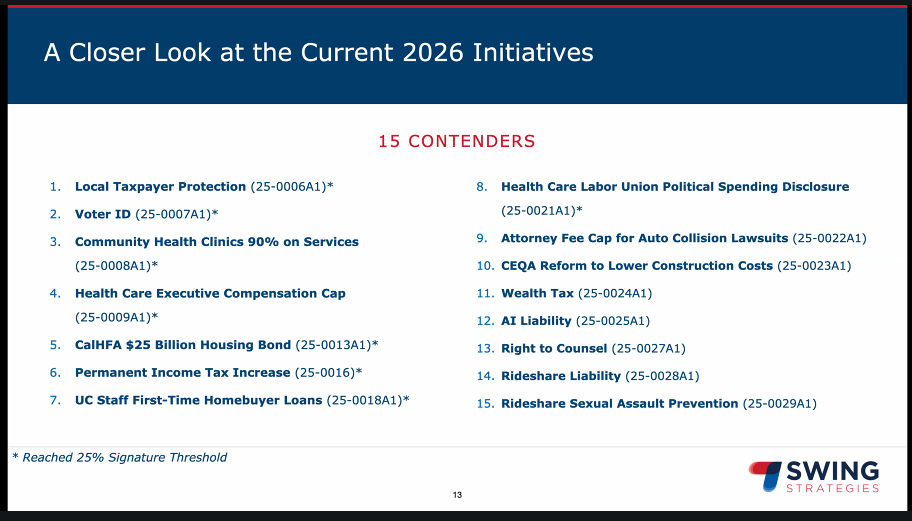
From that list, Swing Strategies isolates what it believes will be the 15 contenders.
More webinars from Swing Strategies will be forthcoming and will be noted in future Main Street Minutes. To get informed sooner, sign up here for Swing’s notifications.
Another Gubernatorial Candidate
Last week, San Jose Mayor Matt Mahan jumped into a crowded Democratic Party field for governor. The Main Street Minute tries to avoid filling its report with the latest political scoreboard of candidates, and the NFIB CA PAC has yet to make any endorsements at all, but we did think it worth mentioning that Mahan was an early supporter of NFIB-backed Proposition 36 in 2024 and is not backing down from his continued support of it.
“In 2024, Mahan supported Proposition 36, a successful ballot initiative that stiffened penalties for theft and drug crimes,” reports The San Francisco Standard. “The measure was opposed by Newsom, creating a lasting fissure between the two elected officials that for months has fueled rumors that Mahan was testing the waters for a run for governor.
— “Last year, Mahan’s critiques of leadership in Sacramento intensified, as he pushed back on Newsom’s call for a special session to fight Trump and called out the governor over his social media tactics, among other dustups.”
Additional information about his policies are available in the following links:
— Mayors like me can’t fix what the state is breaking. We need to demand better
— Opinion: Politicians need performance-based pay. I’ll go first
— What Gavin Newsom and Ro Khanna get wrong in the battle over Billionaire Tax
“Structural Deficit” Explained
From CalMatters’ Dan Walters, Cracks between Newsom and frustrated lawmakers show in first budget hearings.
— “Newsom has steadily opposed major tax increases, even though it was his administration’s immense error in revenue projections four years ago that helped create what officials call a ‘structural deficit,’ meaning that the revenue system cannot generate enough money to pay for all the programs and services now offered.
— “The administration’s 2022 revenue projection error of $165 billion over four years led to Newsom declaring a $98 billion budget surplus and a sharp increase in spending, especially on social services. As an ideological tenet, Democratic legislators dislike cutting those enhancements to balance the budget, which is why increasing taxes was repeatedly mentioned during last week’s hearings.”
Regulations and Business Starts
The Public Policy Institute of California (PPIC), which NFIB has worked with, last week called state policymakers’ attention to its recently released report, Business Regulation and Business Starts in California, which begins with three key takeaways (bolded text added by the Main Street Minute:
— “California is not an outlier nationwide in the quantity of business regulations, but it appears as an outlier for the quantity of specific prohibitions or obligations embedded in business regulations.
— “States with more regulation tend to have fewer business starts, both overall and in manufacturing. While this correlation does not imply that reducing regulation would necessarily increase business growth, California stands out with its relatively higher regulation and slower rate of business starts.
— “Across California cities, less correlation exists between the number of permits required and the rate of business starts; for manufacturing, however, there is more evidence that more permits are associated with fewer new manufacturing business starts.”
And there’s this not-so-fun fact …
… “In total, there are 420,434 such regulatory constraints in California, and the average business is subject to 3,737 constraints (averaged across industries). This is the highest across states, and the median across states is 1,400.”
Latest NFIB California News Release
California Small Businesses Challenge Law Restricting Employer Free Speech
What Others are Saying
Writes the Reason Foundation’s Christina Mojica in this commentary piece, California’s small CEQA workarounds aren’t enough to produce the housing needed, in The Orange County Register:
— “Washington state offers a useful contrast to California because it addressed a similar problem. However, rather than treating housing as an exception to environmental review, Washington amended its environmental review statute to clarify that housing development consistent with adopted plans in the state’s urban areas no longer triggers environmental review by default. Thus, environmental review is no longer structured as a second pass on land use decisions that have already been made through planning.”
“Nvidia Corp. Chief Executive Officer Jensen Huang … made the case that skilled vocational workers are seeing increasing demand now. Plumbers, electricians and construction workers are going to be able to command ‘six-figure salaries,’ thanks to demand to build data centers that run and train artificial intelligence, he said in an interview with BlackRock Inc. CEO Larry Fink at the World Economic Forum in Davos, Switzerland on Wednesday.” – Sacramento Bee, Jan. 26, 2026
Side Notes: According to the NFIB 2024 Tax Survey, the largest percentage of NFIB members, 23.4%, are in the services sector; the third highest, 15.8%, in the construction field. According to NFIB’s latest Jobs Report, “In December, 33% (seasonally adjusted) of small business owners reported job openings they could not fill in the current period, unchanged from November.”
Calendar
— February 20: Last day to introduce bills
— March 26-April 6: Legislature on Spring Break
— May 29: Last day for bills to pass their house of origin
— June 2: Primary Election for eight state constitutional offices, four Board of Equalization seats, all 52 congressional seats, all 80 assembly seats, and 20 (even-numbered districts) state senate seats. Governor’s proclamation here.
— June 15: Deadline (by midnight) to pass new state budget
— July 2-August 3: Legislature on Summer Recess
— August 31: Legislature adjourns its 2026 session
— September 30: Last day for governor to sign or veto bills sent to him.
National
NFIB Webinar, Avoiding Customer Complaints: Best Practices for Data Privacy, Advertising, and Online Reviews, presented by Mary K. Engle, executive vice president for policy, Better Business Bureau (BBB) National Programs; Elizabeth Milito, vice president and executive director, NFIB Small Business Legal Center; and Patrick Moran, senior attorney, Small Business Legal Center. Wednesday, Feb. 4, 12 noon Eastern Time. Click here to RSVP.
Highlights from Federal Government Relations Principal Louis Bertolotti’s weekly report
— Small Business Trends highlighted NFIB’s support for the Credit Card Competition Act, quoting NFIB President Brad Close: “It’s time for Washington to advance the Credit Card Competition Act so small business owners can invest in their own employees and communities instead of Wall Street’s bottom line.”
America’s Small Business Network also highlighted NFIB’s support for the Credit Card Competition Act: “Rising credit card swipe fees are among the most substantial and costly expenses for small businesses nationwide.”
— NFIB Director of Federal Government Relations Josh McLeod was quoted in Federal Newswire regarding NFIB’s coalition letter urging the U.S. Treasury to delete all small business BOI data and expedite a final rule: “NFIB strongly urges the current Administration to destroy the unconstitutionally collected BOI data of America’s small businesses and issue a final rule that will exempt U.S. small businesses.”
— NFIB sent a statement for the record to the Senate Environment and Public Works Committee ahead of this week’s hearing entitled “Hearing to Examine the Federal Environmental Review and Permitting Processes.” Principal of Federal Government Relations Louis Bertolotti said, “We are excited to see broad, bipartisan support for reforms in the federal environmental review and permitting processes.”
Next Main Street Minute: February 9. All Main Streets Minutes can be found on the NFIB website here. Pull down the California tab in the upper-right-hand corner.
State:
Get to know NFIB
NFIB is a member-driven organization advocating on behalf of small and independent businesses nationwide.
Related Articles

Related
April 29, 2026
NFIB Kicks Off ‘No on Measure 120’ Awareness Campaign
Landing page, digital ads bring small business message to members and public
Read More


Related
April 29, 2026
NFIB Urges SC Senate to Pass Small Business Tax, Regulatory Relief
The measures would ease the financial pressure on Main Street.
Read More

Related
April 28, 2026
NFIB Arizona Applauds State Lawmakers’ Effort to Deliver Long Term Tax Certainty
“The bill matters because it puts real tools back in the hands of Arizona employers…”
Read More
Related
April 28, 2026
NH Business Enterprise Tax Relief Will Help Small Businesses
Raising BET filing threshold is a step forward for Main Street.
Read More