


January 30, 2024
NFIB filed briefs in three cases the U.S. Supreme Court considered in January?
Supreme Court Hears Oral Arguments in Three Important Small Business Cases in January?
Loper Bright Enterprises, Inc. v. Raimondo
On Jan. 17, 2024, the Supreme Court heard oral arguments in this extremely significant case. The case asks whether the Court should eliminate judicial deference to administrative agencies on legal interpretations, a concept established in Chevron v. Natural Resources Defense Council.? Chevron deference is a doctrine that allows judges to defer to administrative agencies’ interpretation of a statute so long as that interpretation is “reasonable.” When courts give this deference to agencies in cases, the agencies win. This deference has been around for nearly 40 years and has led to agencies abusing and increasing their power, a weight on the scale in favor of the government and against people and businesses. This leads to Congress drafting unclear laws because it knows that the agency will come up with its preferred interpretation and the courts will rubber stamp it. ? NFIB’s brief urged the Court to overturn Chevron and abandon Chevron deference. It discussed the harm from agency regulation on small businesses, noted how many states have already abandoned Chevron deference, and explained the bad incentives the deference creates. ? More information can be found in NFIB’s press release.?Sheetz v. County of El Dorado, California
On January 9, the Supreme Court heard oral arguments in this case. The issue here is whether the unconstitutional conditions doctrine applies to conditions imposed by legislative bodies. ? The unconstitutional conditions doctrine essentially means that the government can’t place a condition on the exercise of constitutional rights. For a while, courts have made clear that administrative entities in government could not do so. ? In this case, a person wanted to build a house on his land and sought a permit to do so. The local legislative entity imposed an exaction fee of $23,000 to finance road improvements elsewhere in the county. ? NFIB’s brief argued that the Fifth Amendment’s Takings Clause does not distinguish between unconstitutional conditions imposed by administrative personnel and those imposed by legislative bodies.? More information on Sheetz v. County of El Dorado can be found in the release.?Devillier v. Texas
On January 16, the Supreme Court heard oral arguments in this property rights case. At issue is whether a person whose property is taken without compensation may sue directly under the Takings Clause of the Fifth Amendment, even if the legislature has not affirmatively provided them with a cause of action.? The Takings Clause states: “…nor shall private property be taken for public use, without just compensation.” Usually in the law, the legislature must give individuals a cause of action to vindicate their rights.?? NFIB’s brief argued that the Takings Clause is self-executing, and no further legislative action is necessary beyond the Constitution. ? More information on Devillier v. Texas can be found in the press release. ?
Get to know NFIB
NFIB is a member-driven organization advocating on behalf of small and independent businesses nationwide.
Related Articles
Related
July 16, 2026
VIDEO: NFIB’s Holly Wade Analyzes June SBET Report on NYSE Live
WASHINGTON, D.C. (July 16, 2026) – NFIB Research Center Executive Director Holly Wade joined Kristen Scholer on NYSE Live to discuss June’s Small Business Opti…
Read More

Related
July 15, 2026
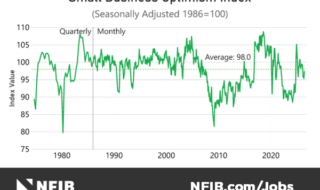
Is Latest NFIB Index the Start of Something Good?
Small Business Optimism survey rose 2.1 points in June survey
Read More
Related
July 15, 2026
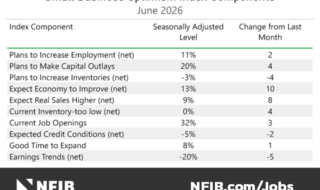
Small Business Optimism Rises in Latest NFIB Survey
Is two-point rise in June an aberration or the start of something big?
Read More

Related
July 15, 2026
State Policies Impacting Small Businesses
States considered small business measures during the 2026 legislative sessions, including taxes, minimum wage, extreme heat standards, IRC conformity, and tort…
Read More