


Topics:
March 19, 2024 Last Edit: July 22, 2024
State Director Eileen Kean submitted testimony to the New Jersey Senate Labor Committee in opposition to S-2822, which revises the workers’ compensation law to increase the cap in contingency fee matters from 20% to 25%.
March 14, 2024
To: Chairman Lagana and Members of the Senate Labor Committee
From: Eileen Kean, State Director NFIB
The National Federation of Independent Business (NFIB), New Jersey’s leading small business advocacy association respectfully opposes S-2822. The bill revises the workers’ compensation law to increase the cap in contingency fee matters from 20 percent to 25 percent.
The costs associated with workers’ compensation benefits are the sole responsibility of the employer and not the worker. Workers never directly pay for their own benefits, which are provided without any coinsurance costs or deductibles that must be met by the workers. Employers may even have deductibles that must be met before their insurer will pay benefits. In New Jersey, unlike other states, small employers are not exempted from providing workers compensation.
Although workers’ compensation laws are meant to provide injured workers with fast relief, the claim process can be complicated and perhaps confusing. It is not uncommon for an employee to hire an attorney to assert their rights. Workers’ compensation lawyers typically take a workers’ case on a contingency fee basis. This means that the lawyer will only get paid if there is a successful recovery of compensation for the injured worker.
Workers’ compensation claims tend to have a greater impact on smaller companies, because larger companies have deeper pockets and larger payrolls that can more easily absorb the financial loss. Larger companies are also more likely to have employees who have experience in managing claims. If an employee of a small business files a claim the rating experience of the employer and thus the workers compensation insurance policy costs increase exponentially.
When lawsuit caps are increased costs and financial outcomes shift creating a further burden on small employers. It is inevitable that raising the contingency fee for attorneys will ultimately be reflected in the workers compensation insurance premiums paid by small businesses.
NFIB respectfully requests that you vote NO on S-2822.
State:
Get to know NFIB
NFIB is a member-driven organization advocating on behalf of small and independent businesses nationwide.
Related Articles

Related
July 27, 2026
Podcast: State Tax Hikes on the Ballot This Year
Experts on the Small Business Rundown discuss proposed state tax increases and the impact higher taxes would have on small businesses across the nation.
Read More

Related
July 27, 2026
Michigan Small Business Owner Featured on NFIB Podcast
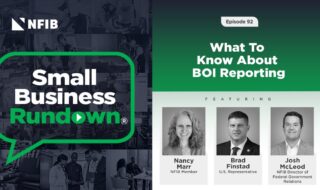
NFIB member Nancy Marr appeared on NFIB’s podcast episode on BOI requirements.
Read More
Related
July 24, 2026
NFIB’s Josh McLeod in Washington Examiner: Congress Needs to Repeal Invasive Beneficial Ownership Reporting Mandate
NFIB’s Josh McLeod in Washington Examiner: Congress Needs to Repeal Invasive Beneficial Ownership Reporting Mandate
Small businesses urge lawmakers to secur…
Read More

Related
July 24, 2026
AUDIO: NFIB’s Beth Milito Joins Iowa Radio to Discuss How Unconstitutional Mandate Threatens Main Street
Iowa small business owners continue urging Congress to repeal BOI reporting requirements
Read More