


Topics:
June 24, 2026
Next steps in school governance reform will impact future property tax bills
After calling for property tax relief throughout the legislative session, Governor Phil Scott signed a bill to reduce the average increase in statewide education property tax bills from 12% to around 3.5% next year.
The projected 12% increase in average bills was driven by higher school spending, rising health insurance and energy costs, inflation, and other factors. The governor and state lawmakers agreed to use a little over $100 million in surplus taxpayer funds to accomplish this buy down.
In 2025, Governor Scott and lawmakers used $118 million to reduce this year’s statewide property tax increase from 6% to 1%.
NFIB VT applauds Governor Scott and the bipartisan group of lawmakers who agreed with the governor’s call for a major buy down.
What about next year? And the year after that? In February 2026, Vermont’s Joint Fiscal Office estimated that it would take $481 million in state funds to hold the statewide property tax increase to 5% per year from Fiscal Years 2027 through 2029.
With federal pandemic-era funds now mostly gone and the population and income influx from domestic migration slowing, the state’s budget picture is tightening. Lawmakers will have a harder time shielding property owners from future tax increases without major reform that reduces school costs.
According to the U.S. Census Bureau, Vermont’s education spending ranks second highest per pupil in the country.
This year’s buy down agreement also included a provision intended to curb “excess spending” as larger education funding reform plays out over the next several years.
What are lawmakers doing about long-term reform? Last year, Governor Scott and a bipartisan group of lawmakers agreed on a package (Act 73) aimed at long-term structural reform to stabilize property taxes and reduce education costs while improving educational outcomes.
This year, lawmakers backed off Act 73’s mandatory school district consolidation plan after a mapmaking committee failed to agree on a plan last fall. Instead, school districts and unions are grouped into 20 regional committees for the purpose of discussing voluntary mergers. Act 170 mandates a range of considerations that must be taken into account by the voluntary merger committees.
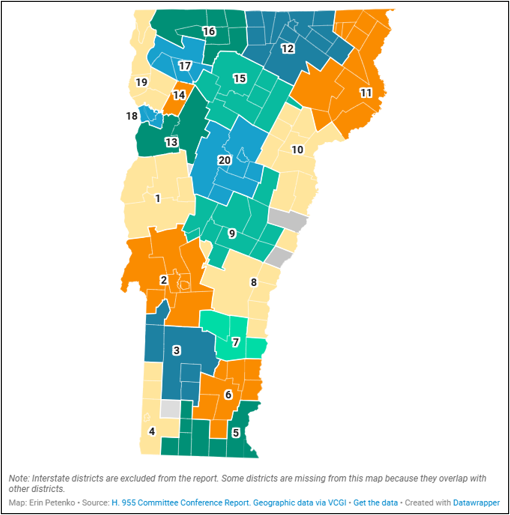
Source: VTDigger.org, 6/19/2026 (click link for interactive graphic)
By September 1, 2027, the voluntary merger committees are required complete their discussions and submit a report to the state and each school district in the region outlining consolidation decisions.
If a merger committee determines that a new consolidated school district is necessary or advisable, it shall be put to a vote in each affected district on March 7, 2028.
The new law establishes additional pathways to consolidation based on local voter approval and requires the state to submit a report to lawmakers on unconsolidated districts with fewer than 750 students by 2029.
While efforts to consolidate school district governance have gotten the most attention, a few pieces from Act 73 and Act 170 will drive long-term changes no matter what happens in the voluntary merger committees.
Foundation Formula. This is the most common method of state financial support for local education. Essentially, a foundation formula is a base amount of money per pupil provided by the state to each school.
A foundation formula is currently used in 35 states and another four partially base state funding levels on a per pupil formula.
Vermont’s base funding amount will start at $15,033 per pupil. There are various adjustments based on various cost-of-service factors like the number of students with special needs in the district.
It replaces the current system where local voters decide spending levels and state lawmakers raise the money through the statewide property tax and other revenue streams into the state’s Education Fund.
The foundation formula is often misconstrued as a state takeover of education funding, even though the state is already nearly entirely responsible for funding education.
The new foundation formula, if implemented, allows local schools to spend a certain amount above the formula based on local decision making. And within the larger framework of state educational requirements built over decades, it leaves decisions on how the money is spent at the local level.
This year’s agreement delays the implementation of a foundation formula by one year to the 2029-30 school year. It also conditions implementation on a list of future actions that must be taken by the legislature, the state, and school districts (see 2026 Act 170, pgs. 50-53).
The path to property tax stability or savings becomes far murkier without a foundation formula or other model that caps the state’s funding liability.
Minimum Class Sizes. In 2025’s Act 73, Vermont schools are required to comply with class size minimums or face corrective action from the state Agency of Education and State Board of Education:
– Grade 1: 10 students
– Grades 2-5: 12 students
– Grades 6-8: 15 students
– Grades 9-12: 18 students
The goal of class size minimums is to ensure that students have adequate education opportunities and to ensure schools are benefiting from efficiencies of scale.
If a school fails to meet the minimum class sizes for three consecutive years, corrective action could include consolidation, closure, or the state assuming control of the school.
This year’s bill effectively delayed the starting clock for attaining compliance with class size minimums until July 1, 2027, so the earlies the state could recommend corrective action is 2030.
Education Service Cooperatives. While Act 170 backs off the mandatory merger plan, it does establish seven Cooperative Educational Service Areas, or CESAs. All existing districts and unions are grouped into a CESA.
CESAs are intended to generate cost efficiencies in the delivery of administrative, business, and educational services. They succeed an earlier initiative known as Boards of Cooperative Educational Services (BOCES).
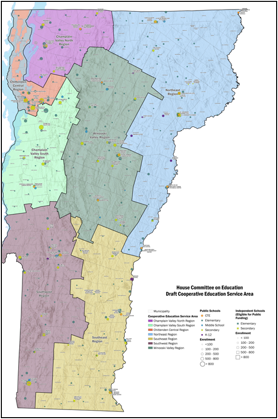
Specifically, CESAs have the power to provide educational programs, services, facilities, and staffing; professional development; curriculum coordination and development; and transportation.
Further, upon the request of member districts, CESAs are also required to offer special education support services; business information and technology administrative services; and consultation and facilitation on union school district creation.
CESAs may address some inefficiencies inherent in Vermont’s highly dispersed school governance structure, but likely cannot address some core issues like student population decline and facility maintenance.
What does this all mean? Whether Act 73 and Act 170 result in a more cost-effective, higher achieving education system depends on the voluntary merger process established in Act 170, whether the foundation formula ever takes effect, and how other pieces like class size minimums play out.
If the last two years or two decades are any indication, much will change before any of this is fully implemented so it’s hard to say whether Vermonters will see property tax relief. It’s even harder to say whether Vermonters will like the new system if it comes together as envisioned.
Some critics say Act 73 and Act 170 are forced mergers by another name. They say minimum class sizes, school construction aid incentives that favor consolidating districts, and the foundation formula will force closures, longer school bus times, and other hard choices no matter what.
They also say the combined effect will limit school choice in tuitioning towns by merging small districts without elementary or secondary schools into larger districts with those schools. This newfound access may prevent tuitioning to schools of their choosing.
Proponents say Act 73 and Act 170 aren’t forcing hard decisions about the future of education and property taxes in Vermont; they’re just starting the clock on difficult conversations that are coming no matter what.
The reality remains that Vermont’s school population has shrunk dramatically in the past two decades (-24% since 2005), there is a massive capital maintenance backlog at current facilities ($6.3 billion over 20 years), and Vermonters have had their fill of tax hikes that don’t address the long-term issues.
And Vermont is not alone in these challenges. Public school enrollment is declining across the country, forcing hard conversations in districts large and small about the future of funding, school closures, and how education is delivered.
State:
Get to know NFIB
NFIB is a member-driven organization advocating on behalf of small and independent businesses nationwide.
Related Articles

Related
July 27, 2026
Shop Small During New Mexico’s Back-to-School Tax-Free Holiday
Certain back-to-school items will be exempt from sales tax from Friday, July 31-Sunday, August 2
Read More


Related
July 27, 2026
Podcast: State Tax Hikes on the Ballot This Year
Experts on the Small Business Rundown discuss proposed state tax increases and the impact higher taxes would have on small businesses across the nation.
Read More

Related
July 27, 2026
Northern Illinois Sales Taxes Increase August 1
The higher taxes in Northern Illinois are to fund the Chicago-area public-transit system
Read More
Related
July 27, 2026
Arkansas’ Sales Tax Holiday Weekend Is an Opportunity to Shop Small
Certain items will be exempt from sales tax Saturday, August 1-Sunday, August 2
Read More