


Topics:
November 19, 2025
Last month, a NYS judge sided with environmental groups and ordered NY to change their climate law or publish final regulations by February 1, 2026.
A year before the Vermont Legislature passed the Global Warming Solutions Act (GWSA), New York adopted its own sweeping climate law known as the Climate Leadership and Community Protection Act.
Similar to Vermont’s GWSA, the New York law establishes a timeline for renewable electricity adoption and greenhouse gas emission (GHG) reduction:
2030: 70% renewable electricity & 40% GHG reduction from 1990 levels
2040: 100% zero-emission electricity
2050: 85% GHG reduction from 1990 levels & net zero emissions statewide
Vermont’s GWSA and the Renewable Energy Standard establish similar standards:
2025: 26% GHG reduction from 2005 levels
2030: 40% GHG reduction from 1990 levels & 100% renewable electricity
2050: 80% GHG reduction from 1990 levels
And like the Vermont Climate Council’s Climate Action Plan that is intended to serve as the operational framework for achieving those targets, New York’s law has a scoping plan that carries significant implications for how people live, work, and do business in the state.
New York’s plan explicitly includes the prohibition installation of gas-powered space and water heating, cooking, and other appliances in new construction beginning in 2025; prohibiting replacement of gas-powered residential appliances beginning in 2030; “nearly all” new passenger car and truck sales being electric by 2030; and “nearly all” vehicles being zero emission by 2050.
Once the scoping plan was complete, New York’s Department of Environmental Conservation (NYDEC) was supposed to issue regulations to implement and enforce the plan by January 1, 2024. However, to date, NYDEC has not taken that step.
New York Legal Challenge: In March 2025, a collection of environmental groups filed a legal challenge to force New York to publish the regulations and implement the law. The challenge was made under a state rule that allows for challenges to administrative actions or to compel state agencies to follow laws and rules.
Essentially, the environmental groups argued the New York law is clear and that NYDEC is required to publish final regulations to implement the law.
In October 2025, a state judge agreed with the environmental groups and ordered the state to either change the law through the legislative process or publish final regulations by February 1, 2026.
New York Said Its Climate Law Is “Not Feasible.”
In opposing the environmental groups’ lawsuit, the New York Attorney General conceded timelines established in the Climate Law were not feasible while blaming a variety of external factors, from foreign wars to changes in federal policy.
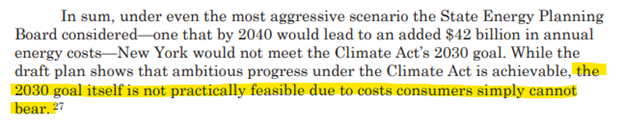
In a memo to the court filed in August, New York admitted:
1) A 40% GHG reduction by 2030 is unachievable based on the state’s analysis.
2) Achieving net zero emissions statewide by 2050 “would require imposing extraordinary and damaging costs upon New Yorkers.” (emphasis added)
3) Regulations that would put the state on track to meet the 2050 target would “raise energy system costs at least 35% in 2040, which is $42 billion in additional costs for that year alone.” (emphasis added).
The memo also takes aim at unrealistic goals for the sale and installation of heat pumps, which it says poses “acute challenges for [low-and-moderate income] households, affordable, housing property owners, and building owners in disadvantaged communities.”
The memo concludes:
What This Means for Vermont
The New York ruling should be a wake-up call to Vermonters about the financial time bomb hidden in the GWSA.
While the Vermont Climate Council has the authority to recommend an action plan, it remains up to state agencies and the legislature to adopt programs, taxes, and regulations that satisfy the GWSA mandates and meet the timeline.
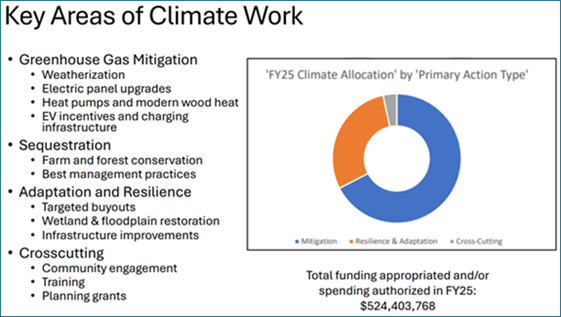
The Vermont Legislature has taken steps to adopt policies that could be part of meeting the GWSA targets, like the idled Clean Heat Tax, but it has stopped short of fully implementing them due to the cost of the most impactful components. Even without massive new programs, the state spent over $500 million on climate mitigation projects in Fiscal Year 2025 alone.
Like New York, the GWSA contains a legal mechanism to compel the state to adopt programs, policies, and taxes to meet the mandates. Lawsuits can be filed by anyone – from individual Vermonters to out-of-state special interest groups – to force the state to adopt plans that are in compliance with the GWSA.
The first such lawsuit was filed last year by the Boston-based Conservation Law Fund and was dismissed in July. The state successfully argued that it did not have the data necessary to determine that additional programs or policies were needed beyond the state’s current action to meet the 2025 GHG reduction requirement.
However, defending against these lawsuits will become harder in the future. The state has already acknowledged it’s unlikely to meet the 2025 goal. As the New York memo shows, it’s likely impossible to meet the 2030 goal and it will be economically devastating to meet the 2050 goal (if it’s even feasible).
Absent significant changes to the GWSA, two things are likely to happen:
1) The Vermont Legislature will be emboldened to adopt new programs and taxes that raise the cost of energy and living in Vermont to meet the GWSA Mandates.
2) Even with those programs, special interest groups, lawyers, and judges may still ultimately take charge of enforcing the GWSA if the mandates are not met – and the costs to Vermonters could be astronomical.
Bottom Line: The New York Attorney General memo shows Vermont lawmakers must get serious about eliminating the GWSA’s Right to Sue and converting the GHG reduction mandates to goals.
State:
Get to know NFIB
NFIB is a member-driven organization advocating on behalf of small and independent businesses nationwide.
Related Articles

Related
April 29, 2026
NFIB Kicks Off ‘No on Measure 120’ Awareness Campaign
Landing page, digital ads bring small business message to members and public
Read More


Related
April 17, 2026
Higher Income and Investment Taxes Will Hurt Vermont
Post-pandemic income migration surge is dropping fast.
Read More
Related
April 15, 2026
NFIB Releases Report Detailing Benefits of 20% Small Business Tax Deduction Becoming Permanent in Vermont
VT is projected to gain 3,000 new jobs annually over the next 10 years if the deduction remains in place.
Read More
Related
April 9, 2026
Mileage Tax Plus A Gas Tax? No Thanks.
Vermont considers adopting a mileage tax for all passenger vehicles.
Read More