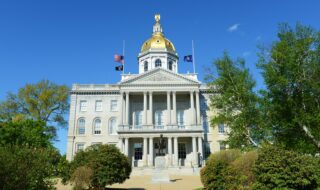
Here's a look at some of the issues NFIB/Kansas will be following in this year's legislative session:
Taxes: Tax policy will simmer as a key issue during the 2012 Kansas Legislative Session. Gov. Sam Brownback formed a tax policy task force of legislators, stakeholders and economists. Charged with designing a proposal that will attract and grow Kansas businesses and the economy, the task force has focused its efforts on plans that would reduce the individual and corporate income tax rates. The administration unveiled its plan during the governor's State of the State Address on Wednesday, Jan. 11. NFIB/Kansas will continue to urge the governor and the Legislature to pass reforms that reduce the rates and complexity of taxes. The Tax Foundation ranks Kansas 35th worst in its annual study of State Business Tax Climates and the Small Business and Entrepreneurship Council ranks Kansas’ tax system the 26th worst for entrepreneurship and small business. NFIB/Kansas will continue to urge lawmakers to pass a bill that would reimburse retailers a percentage of the cost to comply with collecting and remitting sales taxes to the state.
Immigration: Immigration reform is likely to be an issue again in 2012. After efforts in to adopt Arizona-style immigration policy failed in 2011, we expect forces in the House to pursue similar legislation this year. The bill will likely include a requirement that government entities use E-Verify and that businesses that contract with government entities use E-Verify. We will continue to work to ensure that any employer mandates and punishments are not onerous or extreme.
Unemployment insurnace: FIB/Kansas fought for legislation in 2011 to help shore up the unfunded liability in the Kansas Employment Security Trust Fund. However, we are not out of the woods yet. The fund still faces a potential shortage and must pay back Federal loans. We will continue to support changes to the Kansas UI system which restore the integrity of the employer rating system and ensures predictable and low unemployment taxes. And, we will fight for policies which prevent fraudulent or baseless unemployment claims and appeals.
Public pensions: Due to decreased state contributions, weak investment returns and a growing retiree population, the Kansas Public Employee Retirement System is facing a $8.3 billion unfunded liability. Following the 2011 legislative session, a commission was created to make recommendations to solve the KPERS crisis. The Commission has recommended that the legislature adopt a new public pension system that is modeled after private 401(k)-style retirement plans. The current pension obligations are unsustainable and are an increasing drag on the budget which could lead to cuts in services and higher taxes on small business.
Legal reform: We expect lawmakers to focus on three key issues:
- The Kansas Supreme Court continues to mull over a case that could blow the caps off of non-economic damages in liability lawsuits. If the Court rules in favor of removing caps on non-economic damages, the impact on medical costs and insurance rates on small business could be drastically negative. NFIB/Kansas will fight for a Constitutional amendment that restores the non-economic damages caps.
- NFIB/Kansas will fight to restore common-sense liability laws for sellers of second-hand items. The Kansas Supreme Court recently ruled that second-hand sellers are strictly liable for damages caused by the items they sell, even if the seller was not responsible or unaware of product defects.
- Kansas legislators and political leaders have expressed interest in “loser pays” legislation which says some civil plaintiffs who sue and lose will be required to pay the court costs and attorney fees of those they are suing. The law creates expedited civil actions and allows judges to dismiss meritless lawsuits early in the process. As always, we will fight for laws which will result in fewer frivolous lawsuits, lower litigation costs, and more expedient justice for legitimate claims.
Health care: Unless repealed, the federal Patient Protection and Affordable Care Act (PPACA) will require every American who is not on Medicaid or Medicare or those with employer-paid benefits to purchase health insurance in a state-based “exchange” as of January 2014. The governor and many in the legislature have indicated that they will not consider complying with the ACA until the U.S. Supreme Court has ruled on the law. However, many forces are pressing ahead with efforts to implement an exchange and comply with other ACA provisions. We'll continue to fight for common-sense solutions which help to address the continued rise in health insurance costs. In addition, Medicaid costs are sky-rocketing and could bust the state budget in future years. The governor has proposed a new Medicaid paradigm, called KanCare, that seeks to slow the growth of state spending on Medicaid. While there is no direct connection to small business, reigning in Medicaid costs will positively impact government spending and reduce the need to increase taxes on job creators.
School finance: K-12 education represents more than 50% of the state general fund budget and continues to grow. Nonetheless, there are previous and pending court challenges arguing that state spending on schools is underfunded and unfairly distributed. To address these continuing challenges and to achieve budget certainty, the governor has proposed a new school-financing formula. Because it is such a large part of the budget and impact taxes at the state and local level, NFIB/Kansas will closely follow the direction that school funding reform takes in order to protect small business interests.