Small Business Optimism Index
Small Business Optimism Index
June 2026
The NFIB Research Foundation has collected Small Business Economic Trends data with quarterly surveys since the 4th quarter of 1973 and monthly surveys since 1986. Survey respondents are drawn from NFIB’s membership. The report is released on the second Tuesday of each month. This survey was conducted in June 2026.
Small Business Optimism Picks Up in June
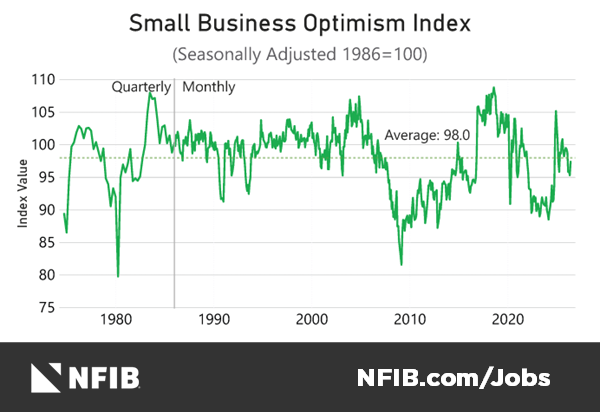
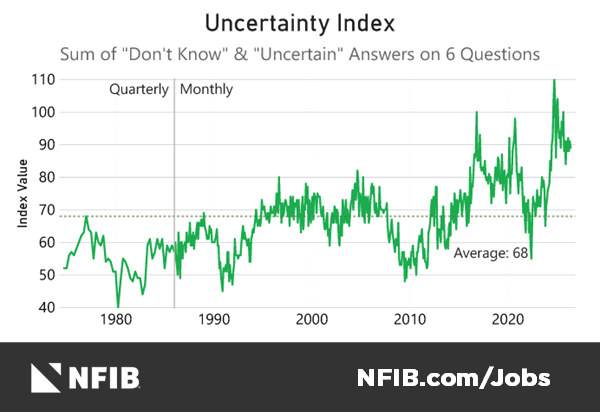
The NFIB Small Business Optimism Index rose 2.1 points in June to 97.4, nearing its 52-year average of 98.0. Expectations for better business conditions and real sales expectations improved substantially and primarily drove the rise in the Index. The Uncertainty Index fell 2 points from May to 89, remaining well above its historical average of 68.
As reported in NFIB’s monthly Jobs Report, the NFIB Small Business Employment Index remained essentially flat, registering 100.2 in June. In June, a seasonally adjusted 32% of small business owners reported job openings they could not fill in June, up 3 points from May’s lowest level since May 2020.


“Current economic conditions present small business owners with both encouraging developments and ongoing challenges,” said NFIB Chief Economist Bill Dunkelberg. “Lower fuel costs provide welcome relief for businesses as well as consumers, with firms anticipating improved operating conditions over the next six months. While there have been improvements in the overall environment, high interest rates and modest economic growth are causing owners to approach hiring and capital spending with caution.”
Key Findings:

Job openings and hiring plans rebounded in June. Thirty-two percent (seasonally adjusted) of all owners reported job openings they could not fill in the current period (up 3 points), and a seasonally adjusted net 11% of owners plan to create new jobs in the next three months (up 2 points). The improvement can be seen as a correction from May’s decline.
Twenty-one percent of business owners cited inflation as their single most important business problem, up 3 points from May and marking the highest reading since October 2024. Inflation ranks as the top problem.
The net percent of owners raising average selling prices rose 2 points from May to a net 38% (seasonally adjusted). This is the fourth consecutive month that actual price increases have risen, marking the highest level since January 2023.
There was good news on the forward-looking inflation metric, as the share of owners planning to raise prices in the near future declined. Looking forward to the next three months, a net 32% (seasonally adjusted) plan to increase prices, down 2 points from May’s highest reading since July 2022.
The net percent of owners expecting better business conditions in the next six months rose 10 points in June to a net 13% (seasonally adjusted), improving for the first time this year.
The net percent of owners expecting higher real sales volumes over the next quarter rose 8 points from May to a net 9% (seasonally adjusted).
Twenty percent (seasonally adjusted) of small business owners plan to make capital outlays in the next six months, up 4 points from May and the highest reading of the year.
A net 0% (seasonally adjusted) of owners viewed current inventory stocks as “too low” in June up 4 points from May and marking the highest level since May 2025.
The average interest rate paid on short-maturity loans was 7.4% in June, down 0.4 points from May and the lowest level since October 2022.
Twenty-two percent of all owners reported borrowing regularly, down 5 points from May. June’s reading is 12 points below the historical average of 34%
The NFIB Research Center has collected Small Business Economic Trends data with quarterly surveys since the fourth quarter of 1973 and monthly surveys since 1986. Survey respondents are randomly drawn from NFIB’s membership. The report is released on the second Tuesday of each month. This survey was conducted in June 2026.
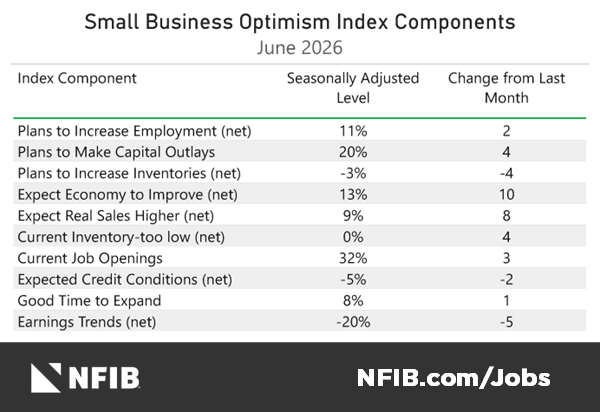
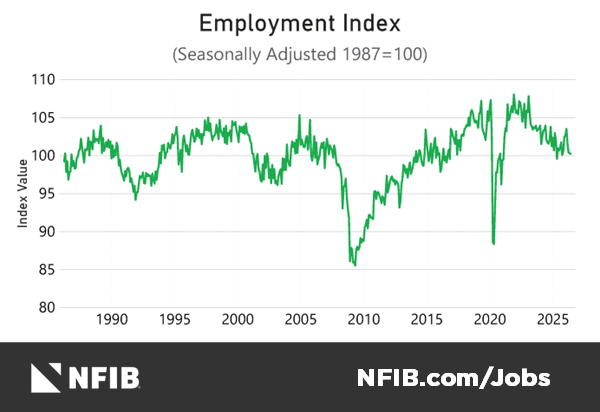
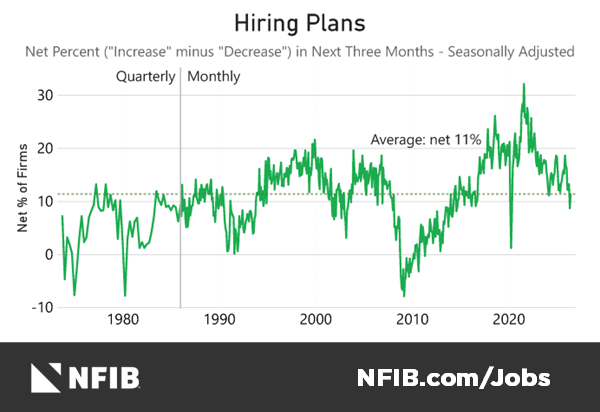
The Employment Index remained essentially flat in June, registering 100.2 in June compared to 100.3 in May. This is the fourth consecutive month in which the Index has declined. The current reading is below the 2025 average of 101.2 but slightly above the historical average of 100.0. In June, 32% (seasonally adjusted) of all owners reported job openings they could not fill in the current period, up 3 points from May’s lowest level since May 2020. Twenty-seven percent have openings for skilled workers (unchanged), and 12% have openings for unskilled labor (up 3 points). Looking ahead, a seasonally adjusted net 11% of owners plan to create new jobs in the next three months, up 2 points from May. Plans to hire are currently at their historical average of a net 11%. Overall, 62% reported hiring or trying to hire in June, up 7 points from May. Fifty-one percent of owners (84% of those hiring or trying to hire) reported few or no qualified applicants for the positions they were trying to fill (up 5 points). This marks the highest level since September 2024. Twenty-seven percent of owners reported few qualified applicants for their open positions (up 3 points), and 24% reported none (up 2 points). In June, 19% of small business owners identified “labor quality or availability” as their single most important problem, up 6 points from May’s lowest level since December 2016. While reports of labor quality or availability as the single most important problem rose in June, reports of labor costs eased. Eight percent of business owners reported labor costs as their single most important problem, down 6 points from May’s historic high reading.
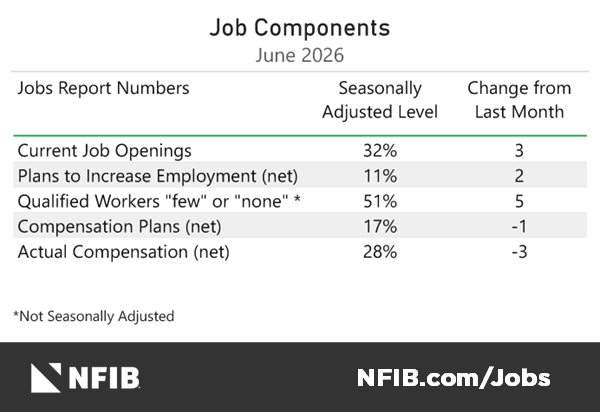
In June, both labor compensation measures declined. A seasonally adjusted net 28% reported raising compensation, down 3 points from May and the lowest reading of the year. In June, a net 17% (seasonally adjusted) plan to raise compensation in the next three months, down 1 point from May.
Fifty-one percent of small business owners reported making capital outlays in the last six months, down 4 points from May. Of those making expenditures, 33% reported spending on new equipment (down 4 points), 25% acquired vehicles (unchanged), and 10% improved or expanded facilities (down 3 points). Ten percent spent money on new fixtures and furniture (down 1 point), and 5% acquired new buildings or land for expansion (up 1 point). Twenty percent (seasonally adjusted) of small business owners plan to make capital outlays in the next six months, up 4 points from May and the highest reading of the year.
A seasonally adjusted net -4% of all owners reported higher nominal sales in the past three months, up 1 point from May. As actual sales volume improved in June, so did real sales expectations. The net percent of owners expecting higher real sales volumes over the next quarter rose 8 points from May to a net 9% (seasonally adjusted). The net percent of owners reporting inventory gains remained at a net -6% (seasonally adjusted). Not seasonally adjusted, 14% reported increases in stocks (up 3 points), and 16% reported reductions (up 2 points). A net 0% (seasonally adjusted) of owners viewed current inventory stocks as “too low” in June, up 4 points from May and marking the highest level since May 2025. A net -3% (seasonally adjusted) of small business owners plan inventory investment in the coming months, down 4 points from May and below the historical average of net 2%. Sixty-eight percent of small business owners reported that supply chain disruptions affected their business to some extent, down 2 points from May. Seven percent reported a significant impact (up 3 points), 21% reported a moderate impact (down 2 points), 40% reported a mild impact (down 3 points), and 30% reported no impact (up 1 point). These disruptions can have significant impacts on inventory stocks and plans.
The frequency of reports of positive profit trends fell 5 points from May to a net -20% (seasonally adjusted). Among owners reporting lower profits, 27% blamed weaker sales, 17% cited rising material costs, and 14% cited price change for their product(s) or service(s). Nine percent cited the usual seasonal change, 8% cited labor costs, and 6% cited taxes or regulatory costs. Among owners reporting higher profits, 48% cited sales volume, 32% cited the usual seasonal change, and 6% cited price change for their product(s) or service(s).
In June, the net percent of owners expecting easier credit conditions fell 2 points to a net -5% (seasonally adjusted). A net 3% reported their last loan was harder to get than in previous attempts, down 1 point from May. In June, a net 5% of owners reported paying a higher interest rate on their most recent loan, down 1 point from May. The average interest rate paid on short-maturity loans was 7.4% in June, down 0.4 points from May and the lowest level since October 2022. Twenty-two percent of all owners reported borrowing regularly, down 5 points from May. June’s reading is 12 points below the historical average of 34%.
The net percent of owners raising average selling prices rose 2 points from May to a net 38% (seasonally adjusted). This is the fourth consecutive month that actual price increases have risen, marking the highest level since January 2023. Actual price increases are well above the historical average of net 14%. Unadjusted, 47% reported higher average prices (up 1 point), and 7% reported lower average selling prices (unchanged). While actual price increases rose in June, the share of owners planning to raise prices in the near future declined. Looking forward to the next three months, a net 32% (seasonally adjusted) plan to increase prices, down 2 points from May’s highest reading since July 2022. Reports of inflation as the single most important problem rose for the fourth consecutive month in June. Twenty-one percent of business owners cited inflation as their single most important business problem, up 3 points from May and marking the highest reading since October 2024. Inflation ranks as the top problem.
When asked to evaluate the overall health of their business, 10% rated it as excellent (down 1 point), 57% as good (up 2 points), 28% as fair (unchanged), and 5% as poor (unchanged). In June, expectations for better business conditions improved for the first time this year. The net percent of owners expecting better business conditions in the next six months rose 10 points from May to a net 13% (seasonally adjusted). In June, 8% (seasonally adjusted) reported that it is a good time to expand their business, up 1 point from May.
Reports of inflation as the single most important problem rose for the fourth consecutive month in June. Twenty-one percent of business owners cited inflation as their single most important business problem, up 3 points from May and marking the highest reading since October 2024. Inflation ranks as the top problem.
In June, 19% of small business owners reported taxes as their single most important problem, unchanged from May and ranking as the second top issue alongside labor quality or availability.
Nineteen percent of small business owners cited “labor quality or availability” as their single most important problem in June, up 6 points from May’s lowest level since December 2016. Reports of labor costs as the single most important problem eased in June. Eight percent of business owners reported labor costs as their single most important problem, down 6 points from May’s historic high reading.
The percent of small business owners reporting government regulations and red tape as their single most important problem fell 2 points from May to 8%. In June, 8% reported the cost or availability of insurance as their single most important problem, unchanged from May. The percent of small business owners reporting poor sales as their top business problem remained at 7%. Five percent reported competition from large businesses as their single most important problem, down 1 point from May and the lowest reading of the year. Three percent reported that financing and interest rates were their top business problem in June, up 1 point from May.
Overview
Current economic conditions present small business owners with both encouraging developments and ongoing challenges. Lower oil prices provide welcome relief for almost all businesses, especially those that rely on transportation, deliveries, and other oil-related activities, while also leaving consumers with more discretionary income. For many owners, easing fuel prices help offset some of the other cost pressures (insurance, supplies/inventories, payroll) that continue to stress profits.
The impact of high fuel prices is made clear in the pricing data: Small businesses have been forced to adjust to higher costs. They have now increased prices for four straight months, and are raising them at the highest rate in three years. Going forward, the recent decline in oil prices is helping small businesses with fewer planning to increase prices over the next quarter and more owners anticipating improved business conditions over the next 6 months.
However, the broader outlook continues to face other headwinds. With inflation well above target, the Federal Reserve is increasingly unlikely to cut interest rates in the near term. As a result, borrowing costs are expected to remain elevated, limiting access to affordable financing for many small firms. High interest rates continue to affect everything from equipment purchases and inventory financing to real estate and expansion plans.
Between the high rates and an economy that is growing at a modest pace, owners are responding with a cautious approach to hiring and capital spending. Consumer spending has remained relatively resilient, but small business owners are concerned about their ability to compete on prices.
Looking ahead, small business owners will further benefit from easing inflation pressures, trying to find ways to limit costs, improve efficiencies, and increase productivity. Implementing AI technologies is one tool that many owners are implementing into business operations to achieve those goals. Until inflation is more under control, the Federal Reserve is likely to keep monetary policy restrictive, leaving borrowing costs elevated for the foreseeable future. Lower fuel prices provide a meaningful tailwind, but sustained improvements in small business optimism will require more than improvement in that one issue.
Quotes – NFIB Members
“One of the biggest challenges is recruiting and retaining qualified plumbing technicians with experience. Because we are located outside of a major metropolitan area, attracting skilled candidates to a smaller town can be more difficult.” – Construction, SC
“Labor rates had to go up because the cost of living is extremely high. Employees are struggling to find decent places to rent within their means and availability. Fuel costs for the business are extremely high. Business and health insurance are getting out of reach. [We] need more tax breaks for small businesses to offset higher labor rates, fuel costs, and insurance rates. The good is that there are more opportunities for work in our area.” – Agriculture, IN
“The need for labor is the top need. We struggle to find good people to hire. It is so bad it makes it impossible to grow even though the sales are out there for the taking.” – Manufacturing, KS
“Skilled labor is hard to find. Good techs are hard to find, and [we] have to pay top dollar and then increase labor rates to cover. So [this is] hurting service businesses.” – Services, PA
“Unskilled labor is very tough to find! […] Other businesses would like to contract us (they can’t find people, so we get more work). However, we have to turn work away due to not being able to hire anyone! Yes, it’s ‘just’ a cleaning job – but we pay competitive rates, offer paid vacation, paid holidays, insurance, retirement plan, etc. – and still can’t find anyone!” – Services, WI
“Finding skilled labor to do my work is slowing my growth.” – Professional/business services, VA
“When USPS raised their rates significantly 2-3 years ago, FedEx and UPS followed suit. Today, my FedEx ground per-pound rate is about 40% higher than my pre-COVID-19 freight rates. These inescapable higher freight rates have a direct negative impact on my business’s ability to ship my heavy parcels to distant customers. Of course, higher gas/diesel prices aggravate this problem as well. My FedEx ground rates increased more in the past three years than they did in the 27 years previously, combined.” – Wholesale, ID
“[We] will not attempt any growth or expansion of services until inflation and price increases are reduced.” – Construction, IN
“Increased fuel prices have added to the cost of products.” – Wholesale, MN
“Fuel cost has added quite a bit of cost on goods, and inflation from that cost has companies slowing down on their spending. Couple that with tariff increases, the cost of everything is quickly becoming unaffordable at a historic rate.” – Manufacturing, IN
“Rising costs are causing clients to cut their costs, and they see cleaning services as a cuttable expense. Minimum wage increases over the last four years have killed us, as clients don’t like price increases.” – Services, CT
“Parts, insurance, everything is more expensive!” – Services, MO
“Labor costs are very high. People are not spending money on going out to eat as much as they used to. Cost of food has increased, very out of control!” – Retail, MN
“Real estate rents (industrial) are at all-time highs. Tariffs and fuel costs are having a severe impact on profitability. Reasonably priced auto insurance for hired and unowned vehicles is difficult to obtain.” – Services, FL
“The costs of inputs – parts for tractors, fuel, fertilizers, chemicals, and seed. Everything has gone up in price except the price we get paid for our rice and walnuts, which has drastically dropped. This will be a bad year for us, and it’s scary.” – Agriculture, CA
“Fuel and tariffs are killing us. The cost of parts to keep our trucks running has risen.” – Transportation, PA “The high cost of housing makes it difficult to pay employees enough to live in California.” – Retail, CA
“Our largest burden is getting carbide for the manufacture of the products we sell. The material is up to seven times the cost of a year and a half ago.” – Manufacturing, WI
“Natural gas and electricity costs for small businesses are outrageous.” – Manufacturing, IL 5 | NFIB Small Business Economic Trends Monthly Report Member Quotes
“Overall, the economy is terrible. We have barely maintained for the past few years. We pay the bills, with little to no profit remaining. This is a small family business, but if this trajectory continues, this business may be closed in the next few years. The timber industry is dying, and the government has helped in no kind of way. Numerous mills have closed, people have lost jobs, expenses are too great for logging crews remaining, and too much product is being imported from South America and South Africa. Yet, American mills must now comply with European ‘green’ standards, compounding the issues faced by timber brokers, logging crews, small mills, and landowners.” – Agriculture, FL
“We’re doing okay despite higher costs in the economy.” – Manufacturing, OH “[The] business environment in my industry (HVAC wholesale) has gotten dramatically worse in the last two years, [as] bad as I have ever seen in my 50 years of working in this business.” – Wholesale, FL
“I would say our economy is volatile. It is hard to trend, and highs are high, but the lows are very low.” – Services, TX “Our business is on the fourth generation in business since 1948. The problems for small businesses are taxes, insurance, and fuel prices.” – Construction, OH
“I have had my store for 51 years. I have seen a lot of changes during that time – when things change, I have to change. The most surprising change is how many of my regular vendors have gone out of business.” – Retail, CA
“Business is steady but not strong.” – Services, VA “Fuel prices are hurting us currently. The cost of labor is very high for us. [We] need to do this in order to keep good people. Taxes kill small businesses. We certainly pay more than we should. Overall, our business is very solid, and we have been blessed over these last 40 years.” – Construction, MI
“Overall, business is good. We are experiencing growth but are having difficulty hiring qualified help. This is a systematic problem that needs to be addressed at the local school level. Both in training for trade/service-type jobs and ethics.” – Services, OH
“It’s a struggle to manage inventory and pay livable wages for full-time employees. We need to increase sales by $150,000 to pay our three employees a livable wage.” – Retail, CO
“Our sales were down in 2025 and are about on the same track this year. I’m adding more inventory this year in hopes it will increase traffic to our store. Cost of merchandise has increased substantially. Wages have increased and [we are] not getting the quality of employees we once had.” – Retail, IL
“Once fuel prices trend down and the future is more predictable this economy should be heading back up.” – Services, OR “Too many people buy online.” – Retail, WA
“Major lack of housing available. We have more buyers than sellers. Lack of appraisers is increasing closing time.” – Real estate, IN
“Automotive repair is more of a need than a want. People are postponing preventative maintenance to the detriment of their vehicles. If given a choice they are opting for the least expensive option possible rather than taking care of their vehicle. Skilled technicians are hard to come by and are demanding bigger pay. Parts are getting more expensive. Cost of oil has gone up too. I have to make my margins, so by the time customers pay the final total price- that number is WAY up!” – Services, CA
“Uncertain times for sure. I am committed to my business, it’s a bigger challenge than a year ago.” – Retail, MT
“Independent community pharmacies are being savagely destroyed by large corporations (PBMs). Although there is a lot of noise and very slow action legislatively, independent community pharmacies and the communities and people they serve are in peril. Many have closed, and many are in danger of closing. Something must be done. Too little is being done at too little speed. It’s like a race between a slug and a sloth.” – Retail, AL 6 | NFIB Small Business Economic Trends Monthly Report Member Quotes
“I sell real estate; I own my own small brokerage. My business is in decline. The big companies are getting the listings. They have bigger advertising budgets to target people who may sell. Listings are the driver of real estate brokerages.” – Real estate, WI
“It is very hard for small business owners to compete with corporately owned competitors!” – Retail, WY
“The price of beef is making it hard to compete with big chain stores.” – Retail, MT “Policy and big corporations are killing small businesses.” – Retail, IN
“Product cost increases are an issue of imports. Bigger companies have greater leverage over these, and we fear we will be less competitive.” – Wholesale, IA
“Our problems stem from customers buying online. We’ve lost sales to that. We can’t compete with those prices.” – Retail, MI
“This year has actually been a better year for us than the past five years. But it is still so difficult to make any profit due to overhead costs. One of the worst of those costs being insurance. We just renewed our workers’ comp., general liability, commercial auto, and medical insurance. And our cost of insurance has almost doubled over last year, and we have never made any claims on any of our policies…” – Construction, CA
“Health insurance is a big concern. At some point it will be too expensive to offer.” – Retail, RI “Insurance costs, both liability and health care, are increasing substantially. It is outrageous!” – Construction, OH
“Insurance companies are trying to pay shops less while increasing the customers’ premiums and deductibles. Insurance steeping is another regular practice which is slowly killing small body shops.” – Services, WA
“P&C insurance companies are getting difficult to deal with. They seem to push back on every legitimate billing item.” – Construction, FL
“Washington State taxes are creating unjustifiable additional operating costs. [It is] difficult for us to remain competitive.” – Retail, WA
“Taxes and available markets are our biggest challenges. Too many insurance companies are in financial trouble.” – Financial/insurance, IL
“Public bureaucracy hamstrings us in every direction, it seems. Things like fuel stickers, registrations, certified payroll requirements, MSHA paperwork, and insurance regulations are crushing our drive to continue.” – Construction, ME
“Farming prices are set by contracts or by the Chicago Board of Trade on grain – [it is] difficult or impossible to raise pricing.” – Agriculture, IL
“Interest rates are affecting buyers which is slowing down building jobs. The high cost of building products is affecting housing starts… thus our production.” – Construction, ID
“We’ve seen an increased use of credit cards and financing needed for purchases of our whole goods as well as parts and service.” – Wholesale, TX
“Tariffs continue to cause uncertainty in the packaging industry, and the war in Iran has affected interest rates and borrowing. The housing market in the South is stagnant while potential buyers are holding off on making offers.” – Services, IL
“Pharmacy Benefit Managers (PBMs) cut our reimbursement every year. They don’t account for the cost of living, hiring expenses, more expensive insurance, or the cost of employees.” – Professional/business services, MN
“I would like to see more focus on reducing credit card fees. Our business is now 90% card, and the fees are eating into a thin margin made thinner by tariffs.” – Services, PA