


Topics:
Small Businesses Urge Administration and Large Companies to Ensure Fair and Efficient Tariff Refund Process
Small Businesses Urge Administration and Large Companies to Ensure Fair and Efficient Tariff Refund Process
April 27, 2026
Survey of small businesses highlights impact of tariff and trade policy
WASHINGTON D.C. (April 27, 2026) – The National Federation of Independent Business (NFIB), the nation’s leading small business advocacy organization, asked the Administration today to continue working to make the U.S. Customs and Border Protection (CBP) online tariff refund portal efficient for small businesses, and called on large companies to make sure they share refunds with their small business partners who absorbed increased costs indirectly.
“America’s small businesses deserve a straightforward opportunity to reclaim their fair share of tariff refunds, and we thank the Administration for getting this system up and running quickly,” said Brad Close, NFIB President. “Big Businesses are already filing lawsuits and lining up for refunds. Main Street should be given the same opportunity as their larger competitors to recover any increased costs that were passed on directly to them. Most small businesses will navigate this process with limited resources and without an attorney or trade expertise. We urge the Administration to continue optimizing the tariff refund process to ensure it is efficient and manageable for America’s small businesses.”
The NFIB Legal Center recently released an update breaking down the CBP online portal and urging small business owners to watch its recent webinar explaining what the Supreme Court’s tariff decision means for small businesses at nfib.com/webinars.
A recent NFIB survey showed:
- Despite low import and export numbers among small businesses, a majority reported noticeable impacts of tariffs on their business.
- Small business sentiment on tariffs is mixed but leans positive: 53% favor the new tariffs to some degree, 29% oppose them, and 19% are neutral, reflecting uneven effects across degrees of tariff exposure.
- Just over half (56%) of respondents reported that tariffs negatively impact operations, including 16% citing a significant negative impact. Eight percent report positive effects, and 35% have experienced no impact so far.
- Of those negatively impacted, 78% of owners reported higher prices for supplies or inventories, 58% reported lower profits, and 43% reported supply chain disruptions due to the change in tariff policy.
- Of those not currently impacted, a slim majority (51%) do not anticipate an impact in the next few months, while 36% say they don’t know, reflecting ongoing uncertainty.
###
For over 80 years, NFIB has been advocating on behalf of America’s small and independent business owners, both in Washington, D.C., and in all 50 state capitals. NFIB is nonprofit, nonpartisan, and member-driven. Since our founding in 1943, NFIB has been exclusively dedicated to small and independent businesses, and remains so today. For more information, please visit nfib.com.
Get to know NFIB
NFIB is a member-driven organization advocating on behalf of small and independent businesses nationwide.
Related Articles
Related
July 20, 2026
VIDEO: NFIB’s Holly Wade Joins Bloomberg to Discuss Rise in Small Business Optimism
NFIB Research Center Executive Director Holly Wade joined Bloomberg: The Close last week to analyze June’s Small Business Optimism Index.
Read More

Related
July 17, 2026
Understanding Service Animal Protections Under the Americans with Disabilities Act (ADA)
When it comes to allowing or restricting service animals in your business, it is important to understand your rights and obligations under the Americans with D…
Read More
Related
July 16, 2026
VIDEO: NFIB’s Holly Wade Analyzes June SBET Report on NYSE Live
WASHINGTON, D.C. (July 16, 2026) – NFIB Research Center Executive Director Holly Wade joined Kristen Scholer on NYSE Live to discuss June’s Small Business Opti…
Read More
Related
July 15, 2026
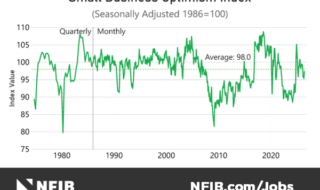
Is Latest NFIB Index the Start of Something Good?
Small Business Optimism survey rose 2.1 points in June survey
Read More