November 12, 2025
Think state taxes are too high? Weigh in now!
Since 2019, Vermont’s budget has exploded from $5.95 billion to $9.1 billion – a 53% increase in six years.
That spending increase was fueled, in part, by COVID-era federal funding and the post-COVID economic recovery that drove higher state tax revenue collections. With those having largely ended, the state is left with a much larger budget and less growth to pay for it.
With inflation still driving up costs, steep rises in public sector healthcare costs, reductions in federal spending, and other headwinds, Vermont faces steep challenges as they work on the next state budget.
Vermont lawmakers face a choice next year:
Raise taxes and fees to continue the spending binge, or…
Right-size the budget and live within existing financial means?
Your Voice Matters: As part of the Fiscal Year 2027 budget process, the Vermont Department of Finance and Management is seeking public input on spending and tax levels.
Take the Vermont Tax and Spending survey here: Public Budget Forum Survey – Fiscal Year 2027 State Budget
The survey offers an opportunity to tell lawmakers which taxes should be reduced to offer relief to small businesses, and which parts of the budget should be targeted for spending decreases or increases.
State Taxes. Vermont’s tax climate already ranks among the least competitive in the northeast and nationally. The nonpartisan Tax Foundation ranks Vermont the worst (50th) for property taxes, 39th for income taxes, and 38th for business taxes.
According to the state’s final monthly revenue report for FY 2025, Vermont’s largest revenue sources last year were:
Statewide Education Property Tax: $1.5 billion
Personal Income Tax (incl. pass-through businesses): $1.4 billion
Sales & Use Tax: $610 million
Revenue has ballooned in recent years (FY 21-FY26):
– Personal Income Tax: +31%
– Sales Tax: +28%
– Corporate Tax: +80%
Despite the revenue growth, lawmakers will be hard pressed to keep spending at current levels as we return to slower economic and population growth while facing myriad affordability challenges.
State Budget. With a third of the state budget dependent on federal aid, this leaves Vermont highly vulnerable to swings in the political makeup and appetite for spending at the national level.
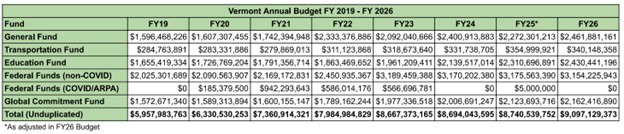
As seen in the chart above, from FY19 to FY26:
– Total (unduplicated) Spending increased by 53% (+$3.1 billion)
– General Fund Spending increased by 54% (+$865 million)
– Education Fund Spending increased by 47% (+$775 million)
– Federal Fund (non-ARRA/COVID) Spending increased by 56% (+$1.1 billion)
(The Global Commitment Fund is part of the state’s Medicaid program, and funds home and community-based services, demonstration projects, and other programs.)
Read more about the Fiscal Year 2026 budget here: 2025 Vermont Legislative Recap Part I: Budget, Housing Development – NFIB
NFIB is a member-driven organization advocating on behalf of small and independent businesses nationwide.
Related Articles