


Topics:
March 10, 2026
How do other states’ energy mandates impact the Granite State?
Each of our fellow New England states have adopted sweeping mandates that require economy-wide greenhouse gas reductions of 80% or more by 2050:
Connecticut: 80% reduction by 2050 (compared to 2001 levels)
Maine: net zero GHG emissions by 2045
Massachusetts: net zero GHG emissions by 2050
Rhode Island: net zero GHG emissions by 2050
Vermont: 80% reduction by 2050 (compared to 1990 levels)
Additionally, each state has imposed requirements for renewable or zero emission electricity production. For instance, Vermont’s Renewable Energy Standard requires that most electricity distributed in the state be 100% renewable by 2030.
These mandates will fundamentally alter how people live, work, and play in those states. The most profound effect will be on people’s wallets: how much they pay to heat and cool homes and businesses, drive cars and trucks, and run equipment and appliances.
There is also deep skepticism about whether it’s possible – let alone affordable – to build an electric grid primarily fueled by weather-dependent renewables and batteries that can meet the demand of an all-electric, zero gas fuel society.
How do other states’ energy mandates impact the Granite State? We know that renewable energy requirements and greenhouse gas reduction mandates in other states will impact New Hampshire’s electricity bills.
A 2024 study by Always on Energy Research found the total cost of building an electric grid that complies with these mandates and could handle the load would reach $815 billion in 2050.
New England residential and small business customers will see their electric bills skyrocket by thousands of dollars per year if the electric grid is built to these mandates and the cost of existing renewable or carbon-free electricity does not rapidly decline.
The Always On study found the average impact would be worse if the Granite State followed suit by increasing its Renewable Portfolio Standard from the current 25% requirement to 100% renewable energy.
What about those “Net Zero” Mandates? The impact on electric bills is steep, but the economy-wide GHG reduction mandates will hit small businesses, consumers, and families in other places too.
A new report by state officials in New York found staggering costs associated with implementing their state’s net zero by 2050 mandate.
The report gives a more encompassing look at the costs associated with net zero emission mandates. People won’t have to wait long to feel the pinch.
By 2031, the average household will face massive increases in total energy costs:
– $4,100 more per year (gross) for the average upstate household
– $7,000 more per year for small and medium commercial businesses
– $2.20+ more per gallon for gasoline and diesel
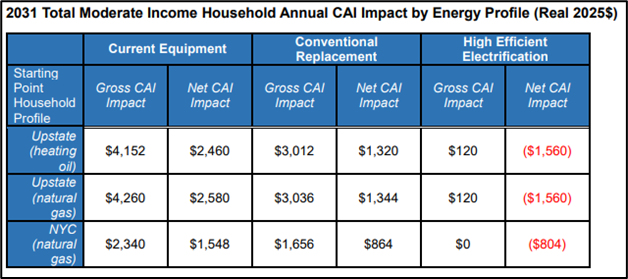
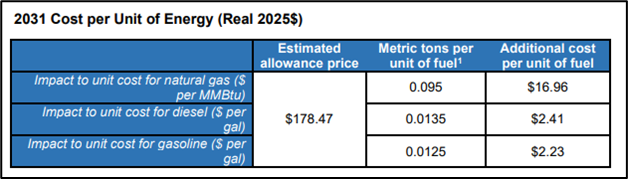
The New York Attorney General’s office called the mandate’s costs “extraordinary and damaging” and said “consumers simply cannot bear” them.
But that’s New York. It’s possible that, by being the only state in the region without this type of mandate, New Hampshire could be a safe haven for businesses and workers seeking relief from sky high energy bills.
But in recent years, net zero mandates and other expensive energy schemes have been proposed in New Hampshire.
In 2021, HB 172 would have set established net zero by 2050 as the state policy. The same requirement would have been established by HB 208 in 2023.
And in 2024, former New Hampshire Executive Councilor Cinde Warmington included net zero by 2040 in her energy platform during her campaign for governor.
Warmington recently announced another campaign for governor in 2026. It remains to be seen whether climate mandates and the corresponding energy taxes will be part of her platform again.
New Hampshire Governor Kelly Ayotte said in her 2026 State of the State Address that expensive Net Zero mandates are a non-starter in the Granite State.
State:
Get to know NFIB
NFIB is a member-driven organization advocating on behalf of small and independent businesses nationwide.
Related Articles
March 31, 2026
Victory for Alaska’s Truckers in NFIB-Backed Initiative
Diesel exhaust fluid requirements removed from EPA regulations
Read More

March 30, 2026
Fair Treatment for New Hampshire Small Businesses
Two proposals would modernize state agency complaint, inspection process.
Read More
March 30, 2026
NFIB California Main Street Minute, March 30-April 3
Update on ballot initiatives; Legislators on Spring Break
Read More

March 27, 2026
WATCH: NH State House Update on Key Small Business Bills
Get caught up on what’s happening in Concord.
Read More