


Topics:
June 30, 2023
Recent episodes covered NFIB’s D.C. Fly-In, worker classification rules, and one-size-fits-all regulations
Get the Latest Small Business Rundown from June
Advocacy Fly-In in Washington, D.C.
 Over 150 small business owners descended on Capitol Hill June 12-14 to advocate for pro-small business policies. They discussed their priorities of preventing a scheduled tax increase for small businesses and injecting real competition to reduce credit card processing “swipe fees” with their lawmakers. In this episode, you’ll hear from a few small business owners who attended the NFIB D.C. Fly-In, NFIB President Brad Close, and Vice President of NFIB Federal Government Relations Kevin Kuhlman about the advocacy event and its impact in Congress.
“NFIB is a nationwide organization, so we do these fly-ins in our state capitals, but every year we do one in Washington D.C. as well,” said Close. “It’s a great opportunity for small business owners to come out and make sure that their congressman, their senators, hear directly from a constituent what matters most to small business.”
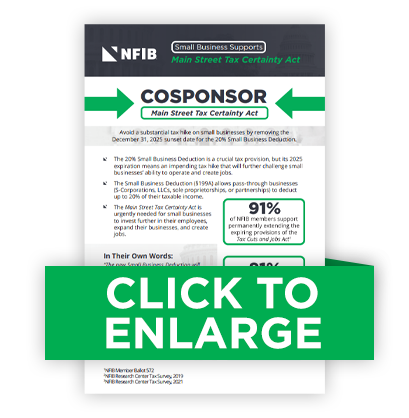
Act now and urge your Senators and Representative to co-sponsor the Main Street Tax Certainty Act.
Over 150 small business owners descended on Capitol Hill June 12-14 to advocate for pro-small business policies. They discussed their priorities of preventing a scheduled tax increase for small businesses and injecting real competition to reduce credit card processing “swipe fees” with their lawmakers. In this episode, you’ll hear from a few small business owners who attended the NFIB D.C. Fly-In, NFIB President Brad Close, and Vice President of NFIB Federal Government Relations Kevin Kuhlman about the advocacy event and its impact in Congress.
“NFIB is a nationwide organization, so we do these fly-ins in our state capitals, but every year we do one in Washington D.C. as well,” said Close. “It’s a great opportunity for small business owners to come out and make sure that their congressman, their senators, hear directly from a constituent what matters most to small business.”
Act now and urge your Senators and Representative to co-sponsor the Main Street Tax Certainty Act.
Worker Classification: The Difference Between Employees and Independent Contractors
In this episode, Executive Director of the NFIB Small Business Legal Center Beth Milito went over how to determine whether your small business’ workers are considered employees or independent contractors. Milito covered the difference between independent contractors and employees, the different tests used to determine classification, and common exceptions. “Generally, employees have greater legal protections under the law,” explained Milito. “They are entitled to unemployment, workers’ compensation, and workplace rights like overtime, sick pay, meal breaks, those sorts of things. Additionally, if somebody is an employee, as an employer you need to pay a portion of that employee’s payroll tax, social security, and Medicare contributions. Independent contractors, on the other hand, are handed a lump sum for their work. They’re paid for a job, not paid by the hour, and they are to report their income on the 1099 form. They are not given any benefits, and the employer does not pay any part of their taxes. They are responsible for the full amount of their social security and Medicare contributions. They are also responsible for withholding income taxes and reporting those quarterly. So, there is a big difference between employees and independent contractors, particularly when it comes to taxes.” For more information on determining a worker’s classification, check out NFIB’s Guide to Independent Contractors.Federal Agencies Disregard Law That Protects Small Business
NFIB member David Henrich joined expert NFIB staff to discuss the Regulatory Flexibility Act (RFA). The RFA is meant to address the disproportionate impact of federal regulations on small businesses. The podcast discussed how federal agencies often fail to abide by the RFA and how a lack of compliance leads to burdensome one-size-fits-all regulations on small businesses. “Our industry has done a really good job for a really long time, so we fly under the radar, but every once in a while, rules pop up that all of a sudden are just massive that sweep you into pools of regulation that you otherwise never were exposed to and really don’t belong in,” David explained. “Because people don’t take time to focus on who can really be impacted by rules, you just inadvertently get caught up in the net.”
To learn more about legislation in Congress that would protect small businesses by enforcing the RFA and take action, visit our website.
Subscribe and share to listen to more episodes of the Small Business Rundown and stay up to date on top priorities and resources for small business owners.
Get to know NFIB
NFIB is a member-driven organization advocating on behalf of small and independent businesses nationwide.
Related Articles

March 24, 2026
TAKE ACTION: Combat Frivolous Lawsuits in Nebraska
Tell Nebraska lawmakers to pass legislation protecting employees’ privacy
Read More


March 24, 2026
Minnesota Small Businesses Challenge Independent Contractor Statute
NFIB joined a lawsuit challenging the new, 14-factor independent contractor test for small businesses in Minnesota.
Read More
March 24, 2026
Navigating Economic Injury Disaster Loans and U.S. Treasury Collection Efforts
For countless small business owners, the COVID-19 Economic Injury Disaster Loan (EIDL) offered critical support during an unprecedented period.
Read More

March 24, 2026
Illinois Small Businesses Oppose Minimum Wage Increase
Small businesses warn of closures & layoffs if minimum wage hike passes.
Read More