Skip to content

Minnesota Members: Marijuana Legalization and Your Small Business

Minnesota Members: Marijuana Legalization and Your Small Business

January 3, 2023 Last Edit: June 5, 2025

Minnesota Members: Marijuana Legalization and Your Small Business
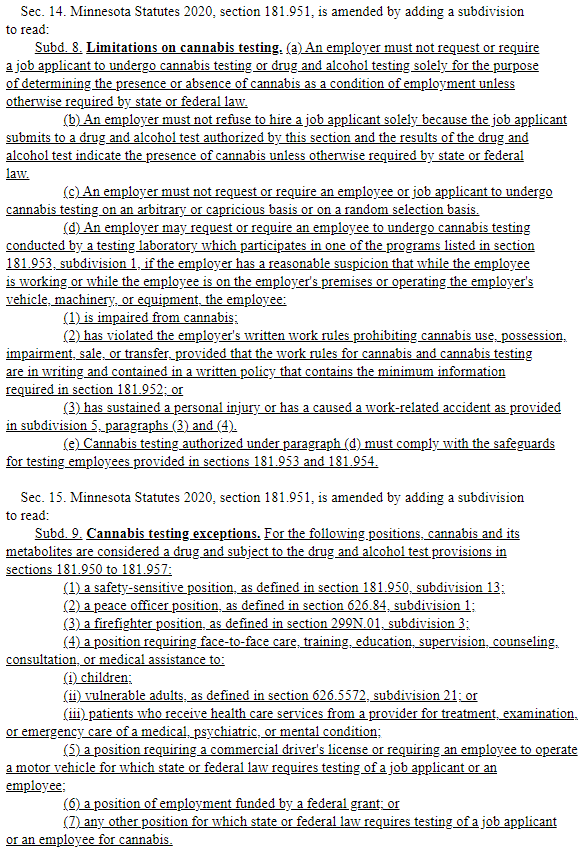
Shortly after winning re-election in November, Governor Walz confirmed that marijuana legalization for adult recreational use is a priority for 2023. Former Governor Jesse Ventura even claimed that Walz told him marijuana legalization will be one of the first bills passed in the new legislative session. Since updated legalization legislation has not yet been released, the implications for small business are not fully clear. But a look back at the Minnesota House DFL’s proposal in 2020 gives an idea of how legalization could impact small employers in our state. That bill (2021 HF 600) was crafted by then-Majority Leader Ryan Winkler (Golden Valley) following a listening tour around the state where locals were invited to discuss the highs and lows of legalization. After the election, Winkler encouraged lawmakers to use this bill as a starting point for legalization legislation in 2023. When it comes to workplace management, a few sections of the bill stand out. In places, the legislation assures employers that they can test or discharge an employee “for cannabis use, possession, impairment, sale, or transfer during working hours, on work premises, or while operating an employer’s vehicle, machinery, or equipment.” However, it also severely restricts an employer’s ability to test for marijuana to certain circumstances: specific occupations identified in the bill, federal/state requirements, or based upon reasonable suspicion of impairment. This raises two big questions for small business that the bill does not fully answer, and there is a lot of gray area that could become a trap for unwitting employers. What is impairment? Impairment is undefined in the bill, so it will likely be up to state courts to decide what level of THC in a person’s blood is considered impaired. While some states that have legalized marijuana have established a concentration level that is considered impaired for vehicle violations, not everyone has settled the question of what level constitutes impairment at work. When is it ok to test? Except for limited enumerated circumstances, the ability to test is left up to an employer’s ability to form a “reasonable suspicion” that an employee is under the influence or impaired. This is a tricky standard, as not every employer is going to be an expert in detecting intoxication or impairment. Lacking a firm basis for requiring a test could invite legal challenges if disciplinary action is taken against an employee. In addition, the bill would bar employers from testing job applicants for marijuana unless required by federal or state law, refusing to hire an applicant based solely on a positive test result, or imposing random, arbitrary, or capricious testing requirements on employees. The rocky rollout of the state’s surprise legalization of low dose THC edibles and beverages in the summer of 2022 shows the details of legalization can get sticky. Cities, employers, and others were left flat footed by the law’s quiet passage and lack of guidance on production, sale, and enforcement. NFIB Minnesota will keep following the legalization issue and work to ensure that small businesses have a right to maintain safe, healthy, and productive workplaces. The bill’s limitations on testing are reproduced in full below.
Get to know NFIB

NFIB is a member-driven organization advocating on behalf of small and independent businesses nationwide.

Receive our newsletter and email notification
Knowledge is power. Let us help you stay informed with breaking legislative news, regulatory updates, business tips, and more.

Related Articles

Related
May 29, 2026
Lawmakers Agree on Much-Needed Workers’ Comp Reform
The House and Senate agreed on final language on Friday.
Read More
Related
May 29, 2026
New Swipe Fee Rule Will Increase Costs for Small Business
NFIB sent a letter opposing a new interim rule that will raise credit card swipe fees for small businesses. Our take: As one of the highest overhead costs fo…
Read More
Related
May 29, 2026
Congress Must Unleash Small Business Growth in New Reconciliation Bill
A recent opinion article explores how Congress can bolster small business growth by passing a tax, regulatory, and healthcare reform bill.
Read More
The State Capitol Building in Montpelier Vermont
Related
May 28, 2026
Bipartisan Agreement Rolls Back Vermont Land Use Restrictions
Rural outcry leads to repeal of “Road Rule” and “Tier 3” restrictions.
Read More

© 2001 - 2026 National Federation of Independent Business. All Rights Reserved. Terms and Conditions | Privacy Policy | Accessibility