


Topics:
April 17, 2026
Post-pandemic income migration surge is dropping fast.
As the Vermont Legislature winds its way to the conclusion of this year’s session, some lawmakers continue to push major tax hikes on personal and investment income.
These taxes would hit small businesses, make it harder to invest in the state and leave Vermont worse off.
Below, we look at how pandemic-era changes fueled state spending growth in Vermont, how that surge is fading, and how higher income and investment taxes would impact the state.
Looking Back at the Pandemic-Era Shifts. As a work-from-home destination during and immediately after the COVID-19 pandemic, Vermont saw modest population gain but a substantial increase in taxable income.
From 2020 to 2024, most Vermont counties saw modest net population gains:
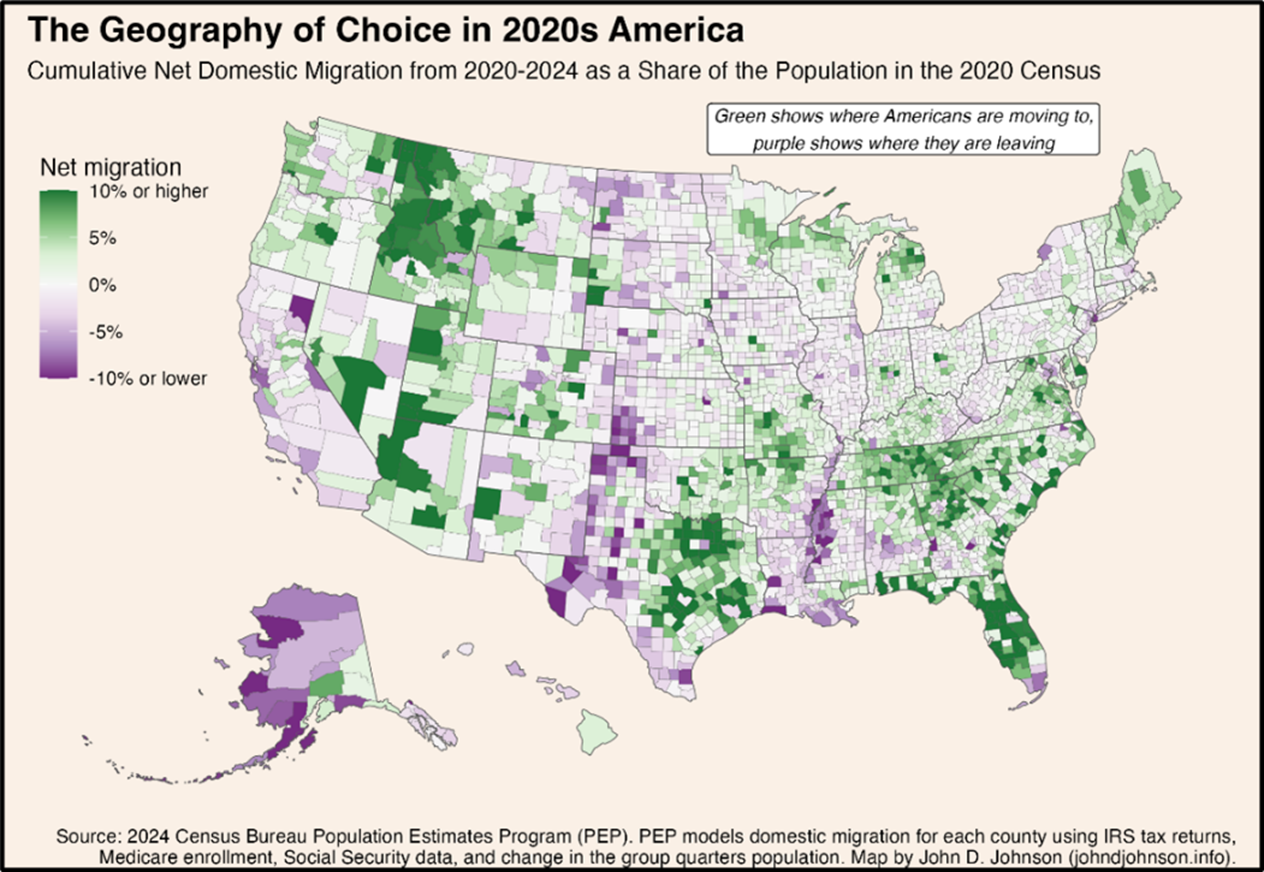
Source: John Johnson, Marquette Law School
Zooming in on Vermont and the northeast:
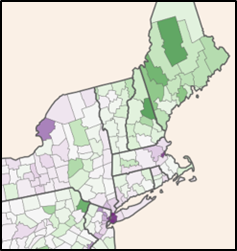
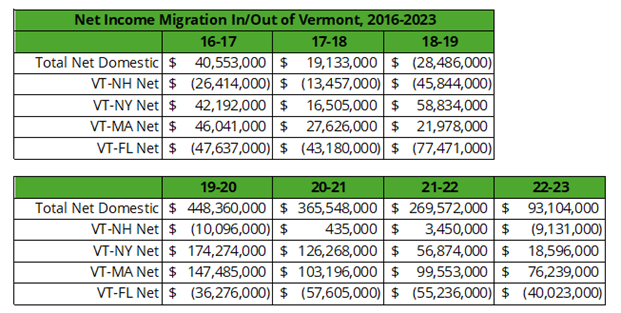
Short-Lived but Substantial Taxable Income Gain. While the net population gain was modest, the amount of net taxable income that came to Vermont was significant.
The chart below uses IRS tax migration data to show the net change in adjusted gross income due to total domestic migration and with the four states with which Vermont has the highest volume of domestic migration:
The surge in taxable income migration from 2020 through 2022 predictably resulted in much higher personal income tax collection levels in 2021 and 2022, as reflected in this Vermont Agency of Administration report from June 2022:
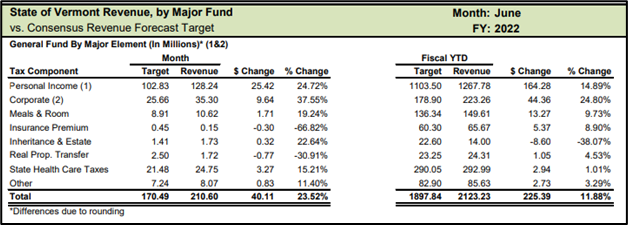
As the agency reported at the time:
“General Fund revenues collected for the month totaled $210.6 million, $40 million above the monthly consensus cash flow revenue target. Fiscal year to date, General Fund revenues were $2.1 billion, exceeding their target by $225 million or about 12%. The June numbers were driven by the same forces as previous months: a strong receipts performance of the Personal Income Tax and the similarly positive receipts performance of the Corporate Income Tax.”
Taxable Income, Pandemic Aid Surge Fuels State Spending. This surge in income tax revenue, along with heaps of federal financial aid during the pandemic, helped fuel a surge in state spending.
Between Fiscal Year 2020 to Fiscal Year 2023, the total state budget grew by 37%, or about 12% per year.
Coming Down from the High. However, by 2023, the sugar high was crashing. In June 2023, the Agency of Administration’s monthly report showed:
“For the fifth month in a row, Personal Income Tax receipts failed to meet their monthly consensus cash flow target, missing by -$9.0 million in June. … Fiscal year 2023’s General Fund underperformance was concentrated predominantly in the Personal Income and Health Care Tax receipt categories which ended the year -$52.6 million (or -4.2%) and -$7.5 million (or -2.3%) below target, respectively.”
The decline in personal income tax collections was likely driven by an 80% drop in the amount of net taxable income coming into Vermont from 2020 to 2023.
Now Vermont Is Considering Extraordinary Income Tax Hikes. This year, major tax hike proposals have been batted around at the Vermont Legislature.
The most recent version of the personal income and investment tax hike would:
– Impose a new top income tax rate of 13.3% – the highest in the country – on income above ~$500,000 for single and married joint filers and ~$300,000 for married filing separate, including small businesses.
– An Extra 4% Investment Tax, modeled on the federal net investment income tax, on filers with total income above $125,000 for married separate, $200,000 for single, and $250,000 for married joint.
The Investment tax would apply to interest, dividends, capital gains, rental and royalty income, non-qualified annuities, income from businesses involved in trading of financial instruments or commodities and businesses that are passive activities to the taxpayer, and more.
According to U.S. Census Bureau data, 92% of all businesses in Vermont are small pass-through entities with zero to 20 employees who pay taxes on their personal income returns.
Small business income can vary widely from year to year. It’s not uncommon for a small business to have a great year where profits hit, say, $750,000 followed by a down year with far lower profits or a loss. Small business owners are not pocketing the good time profit; they are investing back in the business, raising compensation, or saving for a rainy day.
This underscores the challenge of increasing the top tax rate by more than 50% on a large share of their income during good times. Small businesses with volatile income levels have far fewer options to smooth out and lower their tax burden over multiple years.
Will This Help Vermont’s Fiscal Outlook? No. These taxes will make it harder on many small business owners and will make Vermont a less attractive place to relocate, expand, and invest.
As shown above, net gains in taxable income migration from high tax, high regulation states like New York and Massachusetts plays a key role in Vermont’s fiscal health.
If the tax and regulatory climate worsens in Vermont, it will cause that migration to move elsewhere and deepen the state’s budgetary challenges.
The consequences are summed up well by the nonpartisan Tax Foundation’s analysis of a much smaller proposed income tax hike in Michigan:
– Adopting a 9.25 percent top rate would cost an estimated 43,000 jobs, cut wages by about 1 percent, and shrink Michigan’s overall economy by $8.5 billion. The higher tax would also increase net out-migration.
– An examination of high-earner taxes imposed in other states, like California, New York, and New Jersey, shows increased out-migration, the loss of Fortune 500 companies, reduced in-state investment, and slower economic growth.
– If Michigan chooses to follow the path of states like California, New Jersey, and New York, the result would be fewer jobs, lower pay, a higher cost of living, a smaller economy, and growing brain drain as people leave for better opportunities elsewhere.
State:
Get to know NFIB
NFIB is a member-driven organization advocating on behalf of small and independent businesses nationwide.
Related Articles

April 16, 2026
NFIB President Brad Close in Washington Times: Small Business Deduction Is A Big Win For Main Street
WASHINGTON, D.C. (April 16, 2026) – In a new op-ed in The Washington Times, NFIB President Brad Close shares how Main Street is benefiting from the 20% Small B…
Read More


April 16, 2026
VIDEO: Virginia Business Owner Explains How 20% Deduction Boosted Employee Wages
The deduction ‘gives me hope to stay strong.’
Read More

April 16, 2026
What They Are Saying: Virginia Small Business Owner Uses 20% Small Business Deduction for Employee Raises
VIDEO: NFIB member Tina Miller explains how the permanence of the 20% Small Business Deduction has helped her invest back into her business and community.
Read More

April 15, 2026
NFIB Releases Report Detailing Benefits of 20% Small Business Tax Deduction Becoming Permanent in Wyoming
The report also details several other federal tax relief wins that were signed into law.
Read More