


Topics:
April 3, 2026
Index measures taxes paid and value of government services
A new index from WalletHub ranks Vermont 42nd out of 50 states for Taxpayer Return on Investment (ROI). The report compares taxes paid per capita and the quality of government services in each state.
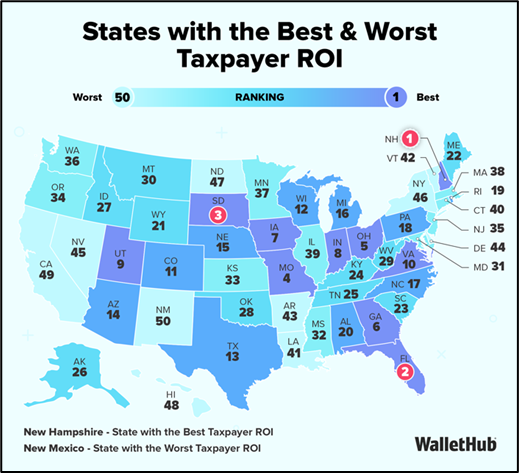
While Vermont scores well for the quality of government services (3rd), its abysmal tax burden (48th) drags the ROI rank down to the bottom ten.
Vermont finished last among New England states, while New Hampshire ranked first for taxpayer ROI.
Low Rank for High Tax Burden. Vermont’s Taxpayer ROI rank matches its place in the Tax Foundation’s 2026 State Tax Competitiveness Index: 42nd.
Tax Foundation’s Vermont profile:
“Vermont levies all major categories of taxation with comparatively high rates and an overall uncompetitive tax structure. As a result, the tax code makes the state both nationally and regionally uncompetitive, particularly compared to neighboring low-tax New Hampshire.”
The Index specifically calls out Vermont’s nation-leading property tax burden, high top individual and corporate rates, and high estate tax. These factors contribute to an economic climate that makes it harder for small businesses to succeed and grow, for the state to attract and keep workers, and for ordinary people to afford living here.
Some Vermont Lawmakers Want to Raise Taxes Even Higher. The 2026 legislative session has seen no shortage of proposals that would make Vermont even more of a high tax outlier.
This includes bills that would double income tax rates for many small business owners and create a souped-up capital gains tax that would make it even harder to invest in the state.
ROI Index Methodology. WalletHub explains its formula as follows:
“In order to determine which states yield the best and worst return on investment (ROI) for taxpayers, WalletHub compared the quality of government services received by residents to the total state and local taxes they pay in each of the 50 states.
“First, we analyzed each state across five key government-service categories: 1) Education, 2) Health, 3) Safety, 4) Economy and 5) Infrastructure & Pollution. The categories were further broken down into 29 relevant metrics, which are listed below with their corresponding weights. Each metric was graded on a 100-point scale, with a score of 100 representing the best quality of government service.
“We then determined each state’s weighted average across all 29 metrics to calculate its “Overall Government Services Score.”
“Finally, we constructed the Taxpayer ROI ranking by comparing each state’s “Overall Government Services Score” to its “Total Taxes Paid per Capita.” “Per Capita” includes the population aged 18 and older.”
State:
Get to know NFIB
NFIB is a member-driven organization advocating on behalf of small and independent businesses nationwide.
Related Articles

Related
July 24, 2026
WATCH: What Happened for Small Businesses During the 2026 Arizona Legislative Session?
Learn what happened in Phoenix during the 2026 legislative session and how it affects your small business.
Read More


Related
July 23, 2026
An Economic Development Bill Should Help Massachusetts Small Businesses, Not Hurt Them
How does adding new hurdles to a law that refunds taxpayers more of their hard-earned money make Massachusetts more affordable or competitive?
Read More

Related
July 15, 2026
State Policies Impacting Small Businesses
States considered small business measures during the 2026 legislative sessions, including taxes, minimum wage, extreme heat standards, IRC conformity, and tort…
Read More

Related
July 14, 2026
NFIB Joins Lawsuit Filed Today in the Oregon Tax Court
“The Legislature cannot circumvent a constitutional requirement”
Read More