


Topics:
January 15, 2026
Reform package would bring new options, more affordable coverage
Two Vermont lawmakers have introduced a suite of health coverage reforms aimed at reducing costs and increasing affordable options in the state.
H.585 (2026) is sponsored by Rep. Patricia McCoy (Poultney) and Rep. Francis “Topper” McFaun (Barre Town). The bill includes many consumer and small business friendly reforms.
>>>>> For a detailed analysis of the legislation and health coverage challenges facing small business owners in Vermont, click here: VT House Bill 585 Will Deliver Better Health Coverage Options – NFIB.
Small Business Healthcare Challenges. Affordable health coverage is a top concern for small businesses. For the past forty years, the cost of employee health coverage has ranked as the number one challenge for small business owners in NFIB’s Problems and Priorities.
In Vermont, the share of small businesses able to offer health coverage has declined precipitously. The share of small businesses offering coverage declined by 21.5% – the third largest drop of any state – from 2009 to 2023.
Now, only one quarter of small businesses in the state offer coverage. Most don’t offer coverage because it is unaffordable and impractical.
Health coverage is a crucial benefit for attracting and retaining employees, and higher costs put small businesses at a major disadvantage with big businesses.
H.585 Improves Small Business and Consumer Options. Vermont has taken several steps over the past decade that have reduced options and increased costs for small businesses.
Taking away affordable options almost always results in higher costs. Sometimes well-intended regulations have the opposite effect.
House Bill 585 starts to reverse some of those mistakes and opens up new opportunities for small businesses.
Association Health Plans (Sec. 7). In 2019, Vermont effectively banned the formation of new Association Health Plans (AHP) and made it more difficult to renew or continue existing plans (Act 63).
AHPs are a vital tool for leveling the health coverage playing field with big businesses. They allow multiple small employers to band together and create a larger pool of employees to enhance purchasing power and lower costs. AHPs typically offer either a fully insured large group plan or a joint-self insured plan.
H.585 removes the prohibition on new AHPs and eliminates inane regulations intended to hinder the ability of small employers to use this option. This is an important step in allowing more affordable options.
Short-Term Health Plans (Sec. 9). Short-Term (ST) health plans are an important product for small business owners, workers of all ages, and early retirees. ST plans are often used by younger people entering the workforce, those between jobs, folks who strike out on their own to start a business, and early retirees.
ST plan prices often range from 25% to 75% less than traditional insurance. They can include coverages and terms anywhere from true catastrophic coverage to something close to a fully regulated individual market plan. People can choose and pay for the level of coverage they actually need, rather than pay exorbitant premiums for a product they may never use.
ST Plans are currently unavailable in Vermont due to strict limitations on how long people can have the policies. The state limits ST plan coverage to no more than three months in a twelve-month period and does not allow renewals.
H.585 would allow short-term plans to have a total duration, including initial term, renewals or extensions, of up to 12 months. This proposal mirrors the longstanding federal regulation in place from 1997 until 2016.
Individual Market Reinsurance (Sec. 13). As noted above, Vermont has the highest individual market premiums in the United States. According to the Kaiser Family Foundation, benchmark (silver plan) premium prices are three times higher than the same plan in New Hampshire and more than double the national average:
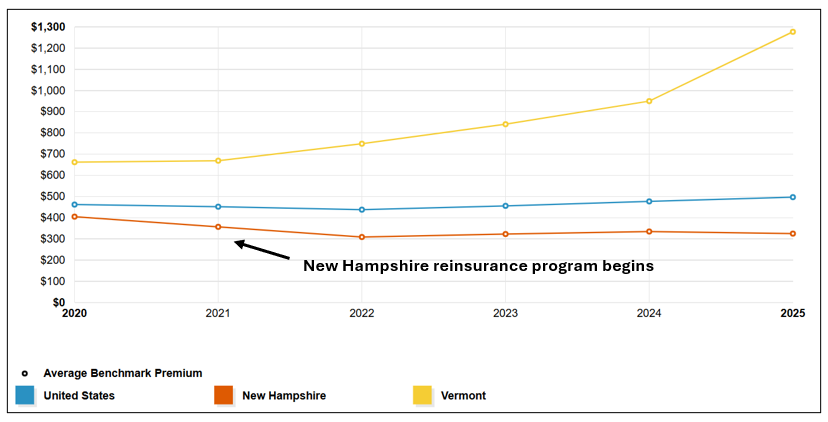
Fourteen states have used ACA Innovation Waivers (Sec. 1332) to launch reinsurance programs that have helped reduce premiums and stabilize enrollment in the Individual Market. These programs typically result in a 20% – 25% reduction in premiums.
In contrast to the highly partisan debates that typically surround healthcare policy, reinsurance has been embraced by deep blue and deep red states alike.

Source: Kaiser Family Foundation
Individual Market Reinsurance is a fairly simple that covers a share of very high cost medical claims – serious car accidents, heart attacks, cancer, chronic disease, etc.
The cost of the program is shared between the state and federal government. The federal share represents savings realized from the federal government paying out less in subsidies (lower premiums = lower subsidies). The savings are then passed through to the state and applied toward the total cost of the reinsurance program.
H.585 authorizes the state to seek a federal innovation waiver to launch a reinsurance program for Vermont’s troubled individual market.
Rate Setting Reform (Sec. 3). A good example of a well-meaning policy that ends up backfiring is the idea that people should not pay more or less for health insurance based on their age.
This policy raises the floor price for young people and pushes them out of the insurance market. When younger, healthier people drop coverage, it makes the risk pool less healthy and causes premiums to increase for everyone else. The cycle repeats itself until states intervene or the market collapses.
The Affordable Care Act limited age-based rating to a 3:1 ratio. In general, this means rates for older policyholders in the individual and small group markets cannot be more than three times higher than those for younger people. Prior to the ACA, many states used an age band limit of 5:1 because it roughly reflected the disparity in healthcare utilization between older and younger populations.
Vermont is one of only two states that has gone beyond the ACA by banning the use of age as a rate setting factor. The state also departs from the ACA version of “community rating” by forbidding consideration of geography and tobacco use in rate setting.
H.585 would allow premiums to vary based on age by up to 5% above or below the community rate – the non-risk adjusted rate. This is intended to make health coverage more affordable for younger people, which in turn improves the risk pool and leads to lower premiums for all.
Conclusion. H.585 is a serious effort at reforming Vermont’s broken health insurance market and making premiums more affordable for working families, small businesses and other consumers.
This bill will restore importance coverage options for Vermonters, including more affordable Association Health Plans and Short-Term Health Plans. It will reduce individual market premiums with reinsurance.
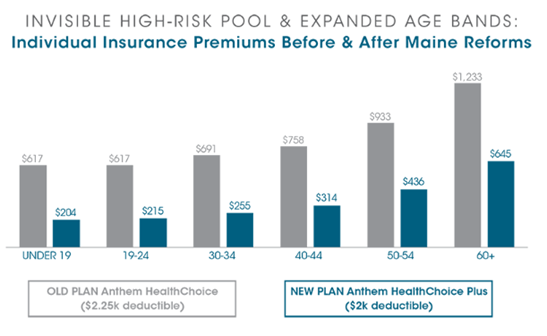
We know from the experience in Maine between 1993 and 2011 that hard reforms are necessary but will pay off for people of all ages and from all walks of life.
In 2011, Maine lawmakers enacted a suite of reforms to lower premiums, stop the downward spiral, and restore health to its individual market. Many of the same reform concepts are found in H.585. The reforms were wildly successful:
With much of Vermont’s health coverage and healthcare systems on the brink, it is imperative that lawmakers from all parties look outside of rigid ideological boxes for fixes.
State:
Get to know NFIB
NFIB is a member-driven organization advocating on behalf of small and independent businesses nationwide.
Related Articles

Related
June 17, 2026
NFIB Joins ‘Stop the Jobs Tax’ Coalition
Medi-Cal recipient formula endangers the most vulnerable employees
Read More


Related
June 15, 2026
Rhode Island Capitol Update
Rhode Island 2026 legislative session wraps.
Read More

Related
June 4, 2026
NFIB Testifies Before Committee on Insurance
NFIB continues to work with lawmakers to improve small business owners’ access to affordable health insurance.
Read More

Related
June 4, 2026
2026 Vermont Legislative Recap Part III: Small Business Regulations
Small businesses will need to watch out for some new regulations.
Read More