


Topics:
April 16, 2024 Last Edit: July 24, 2024
NFIB has a long history and plays a leading role every session promoting legislation that prevents lawsuit abuse and eliminates the threat of unpredictable, frivolous lawsuits.
Lawsuits Hammer Trucking Industry – NFIB has a long history and plays a leading role every session promoting legislation that prevents lawsuit abuse and eliminates the threat of unpredictable, frivolous lawsuits.
The Wisconsin Civil Justice Council reports “a notable trend for the sate’s business community … is an increasing willingness among legislators of both parties to propose new civil causes of action as a way of advancing policy goals.”
Congratulations to the members of the Wisconsin Civil Justice Council for defeating every proposal that included a new cause of action, or successfully amending bills to remove a new cause of action before passage.
Senate Bill 613, introduced by Senate Cory Tomczyk (Mosinee) and Representative John Spiros (Marshfield), would place a reasonable limit of $1 million that may be awarded for non-economic damages as a result of an accident involving motor carriers and commercial drivers.
In addition to economic damages and punitive damages that may be awarded, non-economic damages include intangible costs such as pain and suffering, mental anguish, or loss of consortium.
The trucking industry, dominated by small, independent carriers, is being challenged by financial hardship resulting from non-economic damage awards that far exceed a standard of reasonable and rational.
According to a study by the American Transportation Research Institute, civil verdicts of over $1 million in the trucking industry have increased 967 percent between 2010 and 2018.
This growing trend of excessive awards for non-economic damages is driving up transportation costs, increasing the cost of goods for consumers, and hiking up the cost of supplies for Main Street businesses.
NFIB urged the Governor to sign Senate Bill 613 because it would help address a disturbing trend in the trucking industry by striking an appropriate balance between those who file lawsuits and small business trucking firms.
Trial Lawyers vs. Small Business – Legislation introduced to encourage snow and ice removal procedures that would help protect water quality has been vetoed by Governor Tony Evers.
Senate Bill 52, introduced by Senator Andre Jacque (DePere) and Representative Elijah Behnke (Oconto), would have created a voluntary deicer registration program for firms that apply salt to the roadways and parking lot surfaces of private businesses.
The legislation also created a certification program for deicer applicators and provided liability protection for those firms that apply salt to roadways and have completed the certification program.
Senator Jacque said there has been increasing concern for the growing impact of road salt accumulating in our precious freshwater, “This bill promotes the best practices that help keep both our roads and water safe.”
Once registered and certified, the bill would have provided deicer applicators and the businesses that hire them with protection from lawsuits resulting from hazards (i.e. slip and fall) relating to snow and ice.
The legislation, supported by NFIB, would have provided small business owners and deicer applicators with liability protection so critically needed in today’s world of civil litigation.
Governor Evers, however, said he vetoed the bill because “I object to creating such broad immunity from liability.”
Senate Bill 52 had strong support throughout the business community, and also from numerous environmental groups but was opposed by the Wisconsin Association of Justice.
Allison Madison, Program Manager for Wisconsin Salt Use, reacted to the Governor’s veto, “I’d like to see him step up and take some initiative, he has invested in freshwater in other ways, but to ignore this issue, to me, is really disappointing.”
The lead author in the Senate, Senator Andre Jacque was also disappointed, “Unfortunately, trial lawyers could not stomach the idea of protecting a small business trying to do the right thing by protecting our freshwater resources. That’s one less target they can shakedown for cash in a frivolous lawsuit, so they put the veto pen in the Governor’s hand.”
State:
Get to know NFIB
NFIB is a member-driven organization advocating on behalf of small and independent businesses nationwide.
Related Articles
Related
June 23, 2026
Small Business Property Owners Disappointed By Supreme Court Decision
NFIB is disappointed by the U.S. Supreme Court decision in the case Pung v. Isabella County concerning tax foreclosures and the compensation of property owners.
Read More


Related
June 19, 2026
What to Know About Employing Teen Workers this Summer
In June 2025, over 30% of teens aged 16-19 were employed in the U.S., totaling 5.36 million people.
Read More
Related
June 18, 2026
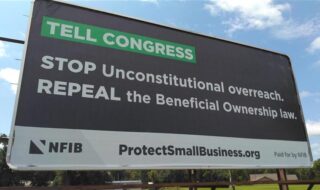
NFIB Releases New Ads in California Urging Rep. Young Kim to Permanently Repeal Beneficial Ownership Information Mandate
Radio, digital ads urge Rep. Kim and Congress to repeal unconstitutional BOI mandate
Read More
Related
June 18, 2026
NFIB Releases New Ads in Idaho Urging Sen. Mike Crapo to Permanently Repeal Beneficial Ownership Information Mandate
Radio, digital ads urge Sen. Mike Crapo and Congress to repeal BOI mandate
Read More