


Topics:
August 1, 2025
New laws authorize towns to adopt local budget caps, sets higher threshold for overriding local tax caps.
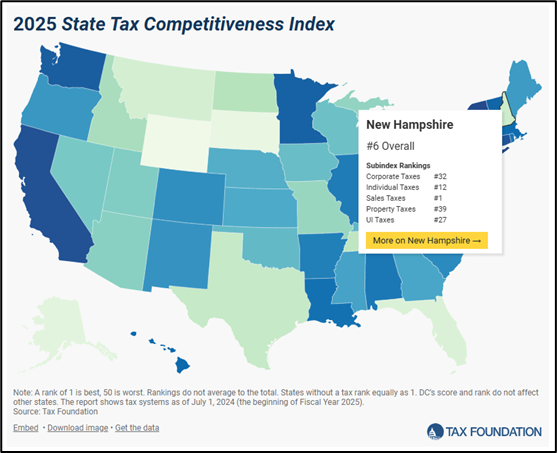
Property taxes are front of mind for most Granite Staters. While New Hampshire receives high marks for its overall tax competitiveness due to the absence of personal income tax and a broad-based sales tax, it lags in business and property taxes.
State lawmakers devoted significant time this year to improving existing property tax tools and adding new ones to empower local taxpayers.
Below we’ll look at the choices lawmakers can make when it comes to reining in local government and school taxes, as well as the new and enhanced local spending restraints that became law this year.
Options For Controlling Local Spending. New Hampshire property owners pay the statewide education property tax (SWEPT), but the bulk of most property tax bills represent money for local units of government: schools, towns, cities.
While New Hampshire is largely successful at restraining overall state revenue, local governments have a more mixed track record. You can compare local tax rates here: NH Dept. of Revenue Administration – 2024 Local Tax Rates.
Given that local spending is often the largest driver of property tax bills, state lawmakers essentially have three options for addressing the issue:
Subsidize. Attempt to reduce local property taxes by further subsidizing local units of government with state funds.
The state currently provides a wide range of local government aid – from Meals and Rooms Tax revenue sharing to school funding – but that has not stopped spending growth by many local governments.
This option is risky since it typically does not require local governments to reduce their spending by the amount of aid. Tying aid to spending or tax restrictions comes with political and practical complications, including determining whether a school district or municipality is actually offsetting or supplementing spending with state aid.
State-Imposed Cap. Enact state-imposed limits on local government taxes and spending, while allowing local governing bodies and voters to override the limits.
Lawmakers explored this option earlier this year for local school district spending. HB 675 would have capped school spending, not including facility acquisition and construction costs, at the rate of inflation through 2027. From there, future spending would be capped at the percentage change in district enrollment. The cap could be overridden by a two-thirds vote in support of additional spending.
That proposal passed the New Hampshire House in March 2025 but was later stripped out of the budget proposal, with most Democrats and a contingent of Republicans opposed based on local control and other factors.
Local Option Caps. Empower local voters to adopt spending and tax caps, which can be exceeded only with approval of voters. Unlike state-imposed caps local option caps must be adopted by voters before they can take effect.
For years, voters in school districts, towns and cities have had the ability to adopt caps on annual property tax increases by a three-fifths vote. Caps can take the form of fixed dollar amount increases, percentage increases, or a multiplication factor (e.g., change in population).
Last year, lawmakers and Governor Sununu created a similar option for local school spending (2024 SB 383). So far, only a handful of districts have adopted per pupil spending caps under the new law.
What’s New This Year? With Granite Staters still concerned about steady increases in their property tax bills, lawmakers wanted to give more teeth to local option tax caps.
Town Budget Caps (SB 105): Sponsored by Senator Keith Murphy (District 16) and signed by Governor Ayotte, this new law allows towns to adopt budget caps to rein in local spending. A three-fifths majority vote is required to adopt and override the caps.
60% To Override Local Tax Cap (HB 200): Sponsored by Representative Diane Pauer (Hillsborough Dist. 36) and signed by Gov. Ayotte, this bill requires a three-fifths majority to override a town or school district tax cap. Previously, local governments could override voter-adopted tax caps by a simple majority.
Proponents of the change argue that it’s unfair to require 60% of voters to approve a cap but allow it to be overridden by a bare majority.
Tax Impact Notice Expansion (HB 138): Also sponsored by Rep. Pauer and signed by Gov. Ayotte, this bill expands the existing local option tax impact notice law by requiring special warrant articles with multiyear tax impact to state the annual tax impact. In towns that have adopted the tax impact notice requirement, voters will have greater transparency on the impact of local spending measures.
Have questions about these changes? Email NFIB New Hampshire State Director John Reynolds: john.reynolds@nfib.org.
State:
Get to know NFIB
NFIB is a member-driven organization advocating on behalf of small and independent businesses nationwide.
Related Articles

Related
April 29, 2026
NFIB Kicks Off ‘No on Measure 120’ Awareness Campaign
Landing page, digital ads bring small business message to members and public
Read More


Related
April 29, 2026
NFIB Urges SC Senate to Pass Small Business Tax, Regulatory Relief
The measures would ease the financial pressure on Main Street.
Read More

Related
April 28, 2026
NFIB Arizona Applauds State Lawmakers’ Effort to Deliver Long Term Tax Certainty
“The bill matters because it puts real tools back in the hands of Arizona employers…”
Read More

Related
April 28, 2026
NH Business Enterprise Tax Relief Will Help Small Businesses
Raising BET filing threshold is a step forward for Main Street.
Read More