


Topics:
March 30, 2026
Key parts of 2024 development reform bill could hurt rural communities.
At the end of March, lawmakers and advocates rallied in Montpelier for action on reforms to Act 181 that may severely limit development opportunities in large portions of Vermont.
Adopted in 2024 over Governor Scott’s veto, Act 181 was an effort to reform the state’s longstanding permitting and review process under Act 250.
In general, Act 181 lowers development barriers in areas that are already developed through a complex series of qualifiers and determinations made by the Land Use Review Board.
To get a sense of the byzantine nature of Act 181, just scroll through this overview by the Vermont League of Cities and Towns.
The proponents’ goal was to consolidate further development near existing cities, villages, and other developed areas. However, there is broad concern that Act 181 could stifle a range of development opportunities – from families dividing farmland for additional homesteads to multiunit development near town centers.
The applicability of Act 250 and exemptions are broken into three tiers:
Tier 1A consists of cities and towns with fully developed zoning regulations and may qualify for a full exemption from Act 250 permitting and review. Think existing water and sewer.
Tier 1B may qualify for an exemption if the development includes 50 or fewer housing units.
Tier 2 largely preserves the status quo with one major exception – the Road Rule. This rule says any development served by a new road that is more than 800 feet, or combination of roads and driveways more than 2,000 feet in total, will trigger Act 250 review.
The Road Rule applies regardless of the number of housing units and poses unique problems for rural villages, family farms, and others.
Tier 3 applies Act 250’s stringent environmental review and permitting requirements to areas deemed fragile ecosystems. Rural residents believe it will prevent new construction of pretty much anything, from one single family home to a shed.
Preliminary mapping by the Vermont Land Use Review Board indicates the reach of Tier 3 is far greater than initially thought.
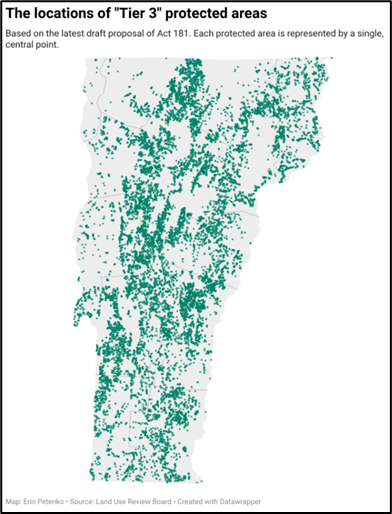
The Road Rule and reach of Tier 3 are causing the most concern. To understand the concerns of rural residents, read this op-ed by Burke realtor Hannah Burrill: Who was Act 181 really written for? – VTDigger.
In the Vermont Legislature, factions are divided into three camps:
1) no change to Act 181
2) temporarily postpone the Road Rule and Tier 3
3) permanent repeal of the Road Rule and Tier 3
Governor Scott and legislative Republicans largely fall into the “permanent repeal” camp, while Democrats are divided into the ‘no change’ and ‘temporarily postpone’ groups.
NFIB VT will continue to follow the debate and update members.
Have concerns with Act 181, Act 250, conservation efforts, or development in Vermont? Reach out to NFIB VT State Director John Reynolds: john.reynolds@nfib.org.
State:
Get to know NFIB
NFIB is a member-driven organization advocating on behalf of small and independent businesses nationwide.
Related Articles

Related
May 20, 2026
Reminder: 2026 Annual Filing Report Due June 30
Pennsylvania small business owners are required to file an Annual Report to the Pennsylvania Department of State. This is a new requirement that started in 202…
Read More


Related
May 20, 2026
NFIB on C-SPAN: How Small Businesses are Managing Economic Pressures
A discussion on C-SPAN featuring an NFIB expert covers the current state of the small business economy and the top issues that are impacting Main Street.
Read More

Related
May 19, 2026
NFIB Thanks Spanberger for Vetoing Class Action, SWaM Bills
The bills would have damaged small businesses.
Read More

Related
May 19, 2026
LISTEN: NFIB Missouri Talks Small Business Economy on Wake Up Missouri
NFIB State Director Brad Jones discusses the latest optimism and jobs report on Wake Up Missouri.
Read More