Small Business Optimism Index
Small Business Optimism Index
May 2026
The NFIB Research Foundation has collected Small Business Economic Trends data with quarterly surveys since the 4th quarter of 1973 and monthly surveys since 1986. Survey respondents are drawn from NFIB’s membership. The report is released on the second Tuesday of each month. This survey was conducted in May 2026.
Small Businesses Report Reduced Optimism
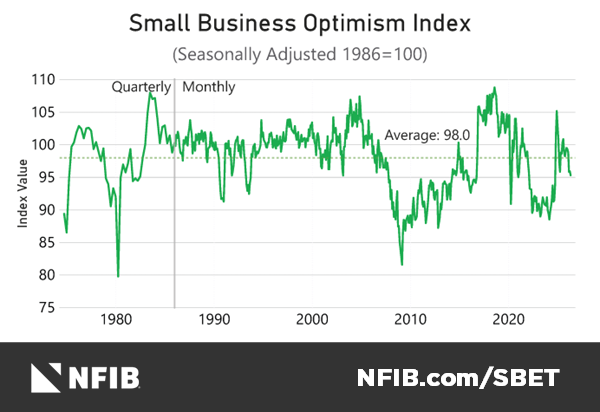
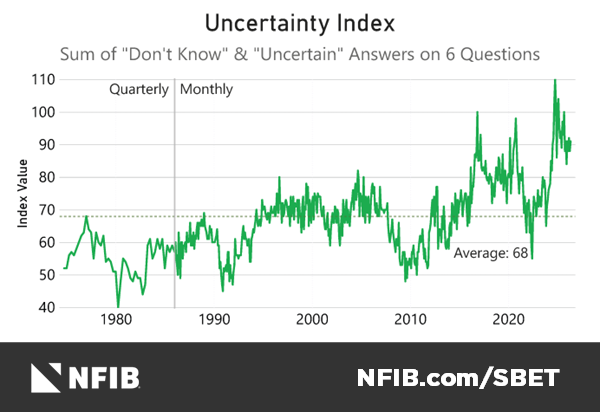
The NFIB Small Business Optimism Index fell 0.6 points in May to 95.3, remaining below its 52-year average of 98.0. The Uncertainty Index rose 3 points from April to 91, remaining well above its historical average of 68.
As reported in NFIB’s monthly Jobs Report, the NFIB Small Business Employment Index remained essentially flat, registering 100.3 in May. The current reading is below the 2025 average of 101.2 but still slightly above the historical average of 100.0. In May, a seasonally adjusted 29% of small business owners reported job openings they could not fill in May, down 5 points from April and marking the lowest level since May 2020.
“AI investment spending has contributed to some excitement in the economy,” said NFIB Chief Economist Bill Dunkelberg. “Despite the enthusiasm around AI, the overall picture is divided. More small business owners are struggling with significant and unpredictable hikes in fuel prices, which are more challenging for small businesses to pass on to their customers compared to their larger corporate competitors.”



Key Findings:

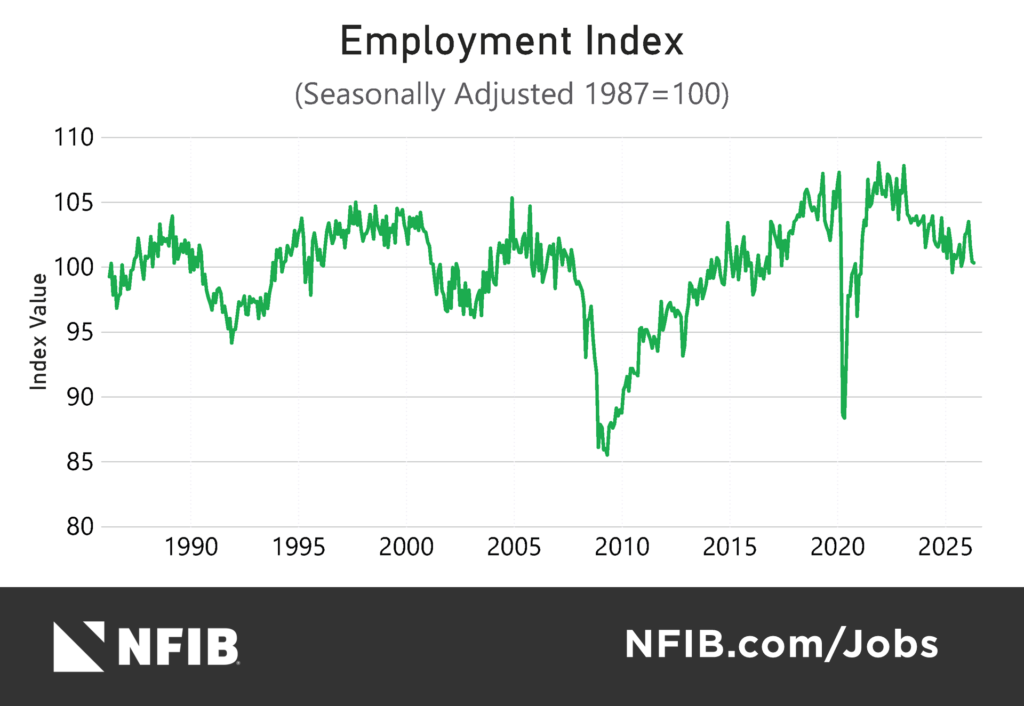
The Employment Index remained essentially flat in May, registering 100.3 in May after measuring 100.4 in April. This is the third consecutive month in which the Index has declined. The current reading is below the 2025 average of 101.2 but slightly above the historical average of 100.0.
In May, job openings and hiring plans fell notably to the lowest levels in six years. Twenty-nine percent (seasonally adjusted) of all owners reported job openings they could not fill in the current period, down 5 points from April and marking the lowest level since May 2020.
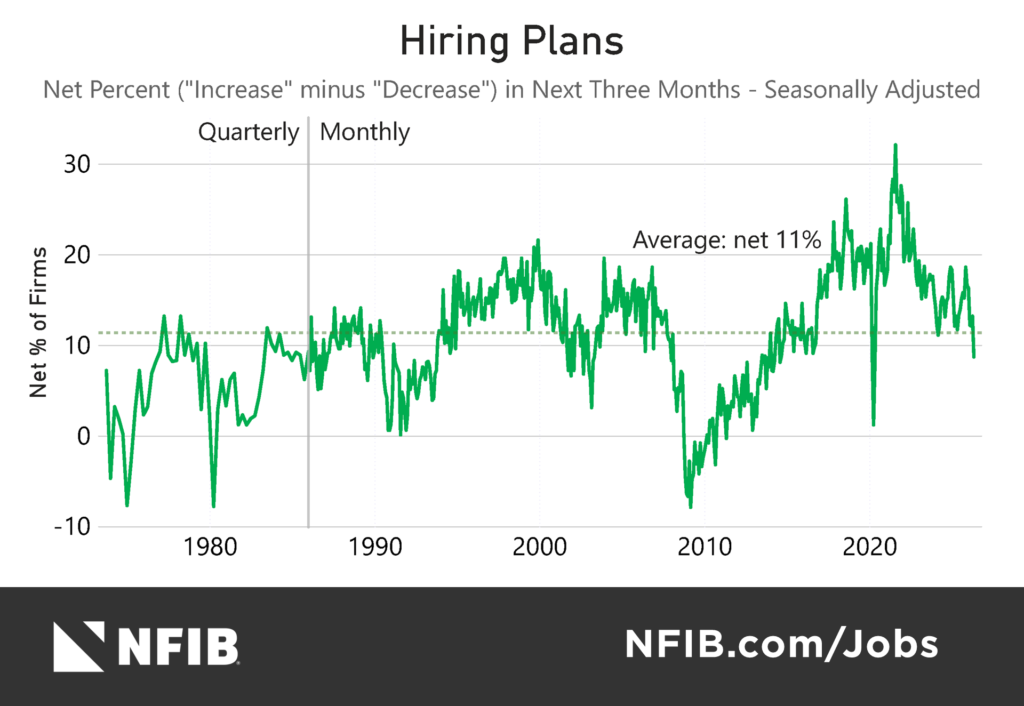
A seasonally adjusted net 9% of owners plan to create new jobs in the next three months, down 4 points from April, also marking the lowest level since May 2020.
In May, 13% of small business owners cited labor quality as their single most important problem, down 5 points from April and marking the lowest level since December 2016.
Fourteen percent of business owners reported labor costs as their single most important problem, up 5 points from April and the highest reading in the survey’s history.
Sixteen percent (seasonally adjusted) of small business owners plan to make capital outlays in the next six months, down 1 point from April and the lowest level since March 2009.
Reports of supply chain disruptions picked up in May, with a shift from those reporting no disruptions to those reporting mild or moderate disruptions. Seventy percent of small business owners reported that supply chain disruptions affected their business to some extent, up 6 points from April.
In May, reports of both actual and planned price increases rose significantly. The net percent of owners raising average selling prices rose 6 points from April to a net 36% (seasonally adjusted), marking the highest reading since March 2023. A net 34% (seasonally adjusted) plan to increase prices, up 7 points from April and marking the highest reading since July 2022.
Eighteen percent of business owners cited inflation as their single most important business problem, up 2 points from April and marking the highest reading since December 2024. Inflation ranks as the second top problem.
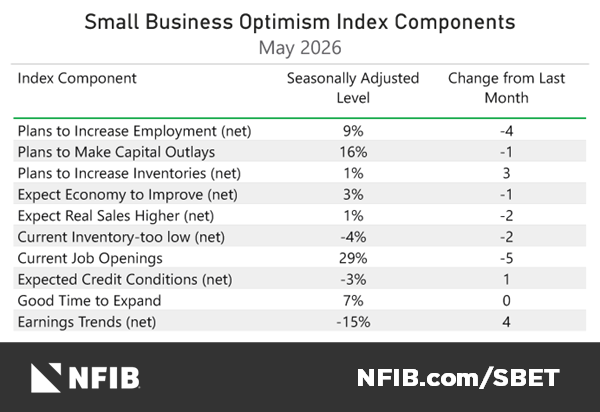
The Employment Index remained essentially flat in May, registering 100.3 in May after measuring 100.4 in April. This is the third consecutive month in which the Index has declined. The current reading is below the 2025 average of 101.2 but slightly above the historical average of 100.0. In May, 29% (seasonally adjusted) of all owners reported job openings they could not fill in the current period, down 5 points from April and marking the lowest level since May 2020. Twenty-seven percent have openings for skilled workers (down 2 points), and 9% have openings for unskilled labor (down 4 points). Looking ahead, a seasonally adjusted net 9% of owners plan to create new jobs in the next three months, down 4 points from April and marking the lowest level since May 2020. Plans to hire are now below the historical average of a net 11%. Overall, 55% reported hiring or trying to hire in May, up 2 points from April. Forty-six percent of owners (84% of those hiring or trying to hire) reported few or no qualified applicants for the positions they were trying to fill (unchanged). Twenty-four percent of owners reported few qualified applicants for their open positions (down 2 points), and 22% reported none (up 2 points). In May, 13% of small business owners cited labor quality as their single most important problem, down 5 points from April and marking the lowest level since December 2016. While reports of labor quality as the single most important problem declined in May, reports of labor costs increased to the highest reading in the survey’s history. Fourteen percent of business owners reported labor costs as their single most important problem, up 5 points from April.
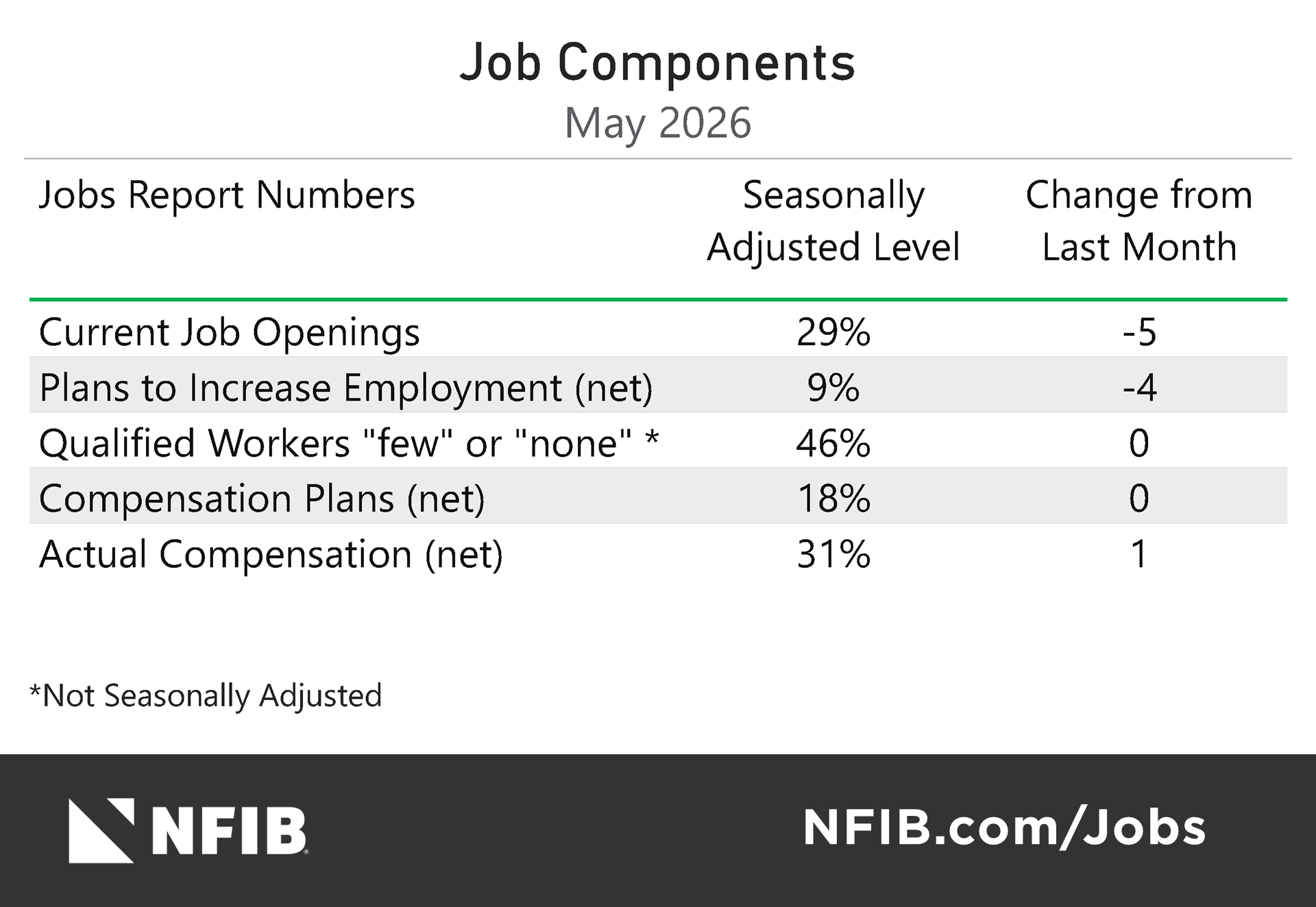
While unfilled job openings and hiring plans declined to six-year lows, compensation measures remained largely unchanged. A seasonally adjusted net 31% reported raising compensation, up 1 point from April. In May, a net 18% (seasonally adjusted) plan to raise compensation in the next three months, unchanged from April.
Fifty-five percent of small business owners reported making capital outlays in the last six months, up 4 points from April. Of those making expenditures, 37% reported spending on new equipment (up 2 points), 25% acquired vehicles (up 2 points), and 13% improved or expanded facilities (down 2 points). Eleven percent spent money on new fixtures and furniture (unchanged), and 4% acquired new buildings or land for expansion (down 2 points). Sixteen percent (seasonally adjusted) of small business owners plan to make capital outlays in the next six months, down 1 point from April and the lowest level since March 2009.
A seasonally adjusted net -5% of all owners reported higher nominal sales in the past three months, up 3 points from April. While actual sales volume increased in May, sales expectations weakened. The net percent of owners expecting higher real sales volumes over the next quarter fell 2 points from April to a net 1% (seasonally adjusted), the lowest reading since April 2025. The net percent of owners reporting inventory gains fell 1 point to a net -6% (seasonally adjusted). Not seasonally adjusted, 11% reported increases in stocks (down 1 point), and 14% reported reductions (down 2 points). A net -4% (seasonally adjusted) of owners viewed current inventory stocks as “too low” in May, down 2 points from April. A net 1% (seasonally adjusted) of owners plan inventory investment in the coming months, up 3 points from April and close to the historical average of net 2%. Reports of supply chain disruptions picked up in May, with a shift from those reporting no disruptions to those reporting mild or moderate disruptions. Seventy percent of small business owners reported that supply chain disruptions affected their business to some extent, up 6 points from April. Four percent reported a significant impact (down 1 point), 23% reported a moderate impact (up 4 points), 43% reported a mild impact (up 3 points), and 29% reported no impact (down 6 points).
The frequency of reports of positive profit trends rose 4 points from April to a net -15% (seasonally adjusted). Among owners reporting lower profits, 32% blamed weaker sales, 16% cited rising material costs, and 14% cited the usual seasonal change. Nine percent cited labor costs, 7% cited price change from their product(s) or service(s), and 5% reported other reasons. Among owners reporting higher profits, 51% cited sales volume, 20% cited usual seasonal change, and 10% cited price change from their product(s) or service(s).
In May, the net percent of owners expecting easier credit conditions rose 1 point to a net -3% (seasonally adjusted). A net 4% reported their last loan was harder to get than in previous attempts, up 1 point from April. In May, a net 6% of owners reported paying a higher interest rate on their most recent loan, up 4 points from April. The average interest rate paid on short-maturity loans was 7.8% in May, down 0.5 points from April. Twenty-seven percent of all owners reported borrowing regularly, up 5 points from April’s lowest level since November 2021.
In May, reports of both actual and planned price increases rose significantly. The net percent of owners raising average selling prices rose 6 points from April to a net 36% (seasonally adjusted), marking the highest reading since March 2023. Actual price increases are well above the historical average of net 13%. Unadjusted, 46% reported higher average prices (up 5 points), and 7% reported lower average selling prices (down 1 point). Looking forward to the next three months, a net 34% (seasonally adjusted) plan to increase prices, up 7 points from April and marking the highest reading since July 2022. Reports of inflation as the single most important problem rose for the third consecutive month in May. Eighteen percent of business owners cited inflation as their single most important business problem, up 2 points from April and marking the highest reading since December 2024. Inflation ranks as the second top problem.
When asked to evaluate the overall health of their business, 11% rated it as excellent (down 1 point), 55% as good (unchanged), 28% as fair (down 1 point), and 5% as poor (up 1 point). In May, expectations for better business conditions continued to decline. The net percent of owners expecting better business conditions fell 1 point from April to a net 3% (seasonally adjusted). This was the fifth consecutive monthly decline in expected business conditions and the lowest level since October 2024. In May, 7% (seasonally adjusted) reported that it is a good time to expand their business, unchanged from April and the lowest level since October 2024.
In May, 19% of small business owners reported taxes as their single most important problem, up 2 points from April and ranking as the top issue. Reports of inflation as the single most important problem rose for the third consecutive month in May. Eighteen percent of business owners cited inflation as their single most important business problem, up 2 points from April and marking the highest reading since December 2024. Inflation ranks as the second top problem. Laborrelated issues saw notable changes this month. Fourteen percent of business owners reported labor costs as their single most important problem, up 5 points from April and the highest reading in the survey’s history. Labor costs now rank third among the top issues. While labor costs rose in May, labor quality fell. In May, 13% of small business owners cited labor quality as their single most important problem, down 5 points from April and marking the lowest level since December 2016. The percent of small business owners reporting government regulations and red tape as their single most important problem rose 2 points from April to 10%. In May, 8% reported the cost or availability of insurance as their single most important problem, unchanged from April. The percent of small business owners reporting poor sales as their top business problem fell 3 points from April to 7%. Six percent reported competition from large businesses as their single most important problem, down 1 point from April. Two percent reported that financing and interest rates were their top business problem in May, down 1 point from April.
Overview
Part of the economy is on a sugar rush – almost all related to AI investment spending and it’s flying high. The stock market is posting new highs, but again, mostly due to that one soaring sector. Meanwhile, gas prices have spiked reflecting a reduction in the global oil supply, but also the risk premium that war has produced. Oil is a cost component in just about everything, so its rising price shows up in just about everything. A net 36% (seasonally adjusted) of the owners reported raising their selling prices, well above the historical average of net 13%. This leads right into CPI inflation, which is too strong to give the Fed license to reduce rates. It may even consider raising its policy rate.
The employment picture looks increasingly gloomy, as job openings continue to decline. Openings fell to 2020 levels as did hiring plans— recession numbers without a recession. Sales prospects are not strong, but not falling apart. Perhaps the economy is becoming bifurcated, one piece driven by AI spending, rising asset prices (e.g. stocks) and spending by higher income consumers benefiting from AI, while the other piece suffers from rising costs.
Uncertainty is the enemy of growth and investment, and it is high. Much is related to the Iran War and its impact on the global oil supply and other commodities, the sooner it’s resolved, the quicker some “normality” will be restored.
Quotes – NFIB Members
“Our labor struggle is blue-collar, especially entry level in our warehouse. We have applicants not show up for interviews and others apply, interview, accept, and not show up for work.” – Wholesale, OH
“Labor is in short supply for all levels.” – Agriculture, MI
“You can’t find anyone qualified who wants to actually work!” – Transportation, OH
“The Minnesota paid family leave program gives money to the employees to take off but leaves the business to suffer the loss of productivity and client pressure. I can’t hire someone to do these jobs on a temporary basis. I wish the politicians who voted this new problem into existence would feel the financial pain of their poor decisions.” – Finance & Real Estate, MN
“Skilled labor like technicians and mechanics are hard to find. Unskilled labor was very challenging during Covid and then improved and is now worsening again.” – Services, NY
“2020 was the best year in our history, since then we do the same work for less money. Prices for everything have increased, wages have increased, but my bid prices have not, net earnings are down.” – Construction, TX
“Our company trucks have felt huge impacts with the cost of truck and health insurance, fuel prices, and cost of equipment and parts. All of these are increasing much faster than we can increase these costs to our customers.” – Transportation, OH
“I’m a dairy farmer and milk price is still way too low with high input costs of everything, from parts, equipment, seeds, and fertilizers.” – Agriculture, WI
“We own a diesel and gasoline pickup repair facility. The ‘temporary’ huge increase in the cost of fuel, groceries, etc., is really hurting our company right now.” – Services, NV
“While the tax burden has remained relatively low in our state and federally, the demand for money has increased, and as a result, decreased our bottom line. Supply costs and supply availability are hitting us hard. Add to that, increased fuel costs, increased wages, increased insurance premiums (both property and health)- the list goes on. Sales are not keeping pace with the increased costs.” – Retail, OH
“Agriculture can be a tough industry. Supply and demand dynamics control too much of our pricing, and a good year of production can end up as a bad year farming because oversupply drives down prices.” – Agriculture, WI
“Overall business is down. Costs are up and we just aren’t sure where to go from here.” – Retail, MO
“Auto and liability insurance is difficult to get, and [the] cost is out of control!” – Professional/business services, CA
“These are just really hard times for a small business. Especially in the woodworking manufacturing business. Too many large companies are undercutting the small guy and controlling the wood markets. Work is slow due to a decrease in demand.” – Manufacturing, NC
“The tariff climate is hurting our business. We are losing sales and our material costs are going up (even though we buy heavily domestic). Also, we’re trying to plan a $10-15 million expansion, and all the high interest rates, gas prices, and economic uncertainty are making it difficult to commit to.” -Manufacturing, MT
“Economic uncertainty is the biggest challenge in our industry. The political climate and decisions have left businesses very cautious. Tariffs and the war have had a negative impact on this past year.” – Construction, AZ
“Uncertainty of supply and price of commodities has been a concern.” – Manufacturing, MN
“As a small business owner operating a Subchapter S Corp. in the services sector, my biggest challenge right now is the uncertain political climate. It makes planning difficult, especially with midterm elections approaching. While our sales volume has increased slightly over the last quarter, net earnings are only marginally higher due to rising labor costs. We’ve made some capital investments in improved building and equipment recently, but we have no plans for major expansions in the next 3-6 months, we’re staying cautious.” – Services, CA
“A serious deterrent to growth is the tax placed on inventory balance at the end of the year. This deters growth. Eliminating or reducing this tax would allow businesses to put more investment into growth and expansion.” – Retail, PA
“Property taxes are my largest threat. If I have a bad year and lose money, I pay no income tax but still am hit with property taxes. When things are tight, that is the largest threat that could take away my land and business. How do I own the land if I can have it taken from me for not paying taxes even when I didn’t make any money?” – Services, TX
“Taxes are too high; business seems to be getting harder and harder to make a profit.” – Manufacturing, UT “Government regulations and fuel costs are killing the trucking industry. That takes a huge toll on our business, as well as the entire economy. Stop the green regulations on engines and let these truckers make a decent living. That would go a long way for the American economy. Get fuel costs in line. This is hurting all of us.” – Retail, MN
“Sales are typically lower in Q1, but we have noticed that it stayed lower longer than usual. Utilities have gone up, payroll has gone up, and sales are down, so all this has contributed to Q1 2026 being worse for us than Q4 2025. Oil has also gone up pretty much every couple of months, so this has affected our bottom line. But the number one issue is lack of business coming in.” – Services, OH
The NFIB Research Center has collected Small Business Economic Trends data with quarterly surveys since the fourth quarter of 1973 and monthly surveys since 1986. Survey respondents are randomly drawn from NFIB’s membership. The report is released on the second Tuesday of each month. This survey was conducted in May 2026.